PortSwigger
Lab Description (from PortSwigger)
This lab demonstrates DOM-based client-side cookie manipulation.
Objective: Inject a cookie that will cause XSS on a different page and call theprint()function. You will need to use the exploit server to direct the victim to the correct pages.
Step 1: Understanding the Vulnerability
DOM-based cookie manipulation occurs when:
- Client-side JavaScript reads data from an attacker-controlled source (e.g., URL)
- That data is written to a cookie without sanitization
- Another page reads that cookie and uses it in a dangerous sink (e.g.,
innerHTML)
In this lab:
- The home page uses a client-side cookie called
lastViewedProduct - The cookie stores the URL of the last product page the user visited
- A different page (or the same page on load) uses this cookie value unsafely
Step 2: Reconnaissance
-
Open the lab homepage
-
Browse to a product page (e.g.,
/product?productId=1) -
Check browser cookies (Developer Tools → Application → Cookies) Observed behavior:
- A cookie named
lastViewedProductis created - Its value is the URL of the visited product page
- A cookie named
-
Look for where this cookie is used. Check the homepage source for:

Step 3: Crafting the Payload
Goal: Call print() via XSS.
The vulnerability exists if:
- The cookie value is taken from the URL (attacker can control it)
- The cookie is later written to the DOM without sanitization
Strategy: Poison the lastViewedProduct cookie with a JavaScript payload that will execute when the homepage loads.
Step 3.1: Finding the Injection Point
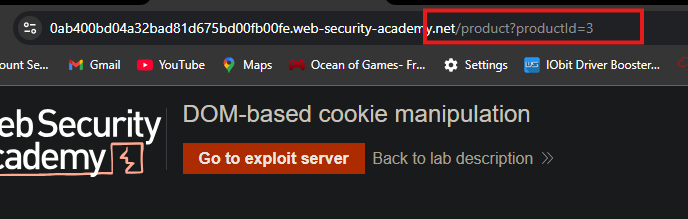
The product page URL might look like:
/product?productId=1
Potential injection:
/product?productId=1'><script>print()</script>
Why this works:
- The entire URL becomes the cookie value
- If the homepage inserts this URL into an HTML attribute without escaping, the
'breaks out of the attribute, and><script>injects a new script tag
Step 3.2: Complete Malicious URL
https://YOUR-LAB-ID.web-security-academy.net/product?productId=1&'><script>print()</script>
Step 4: Building the Exploit
The exploit needs to:
- Send the victim to the malicious URL to poison the cookie
- Redirect the victim to the homepage without them noticing
- The homepage then triggers the XSS
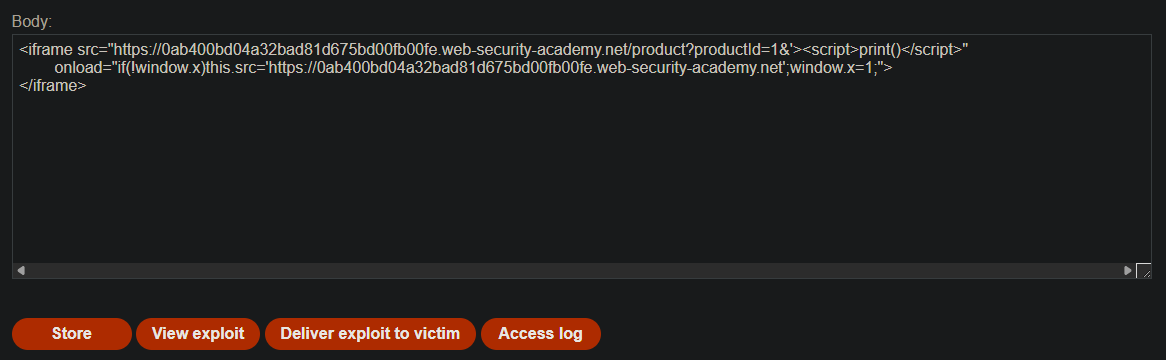
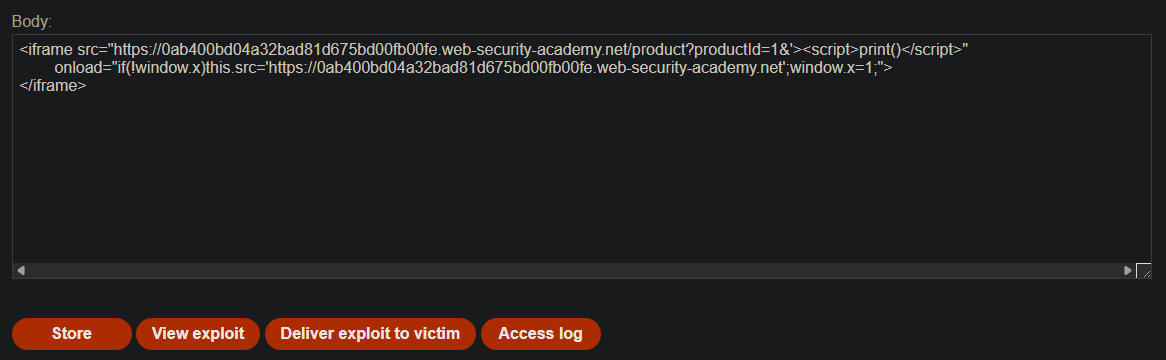
Exploit Code:
<iframe src="https://YOUR-LAB-ID.web-security-academy.net/product?productId=1&'><script>print()</script>"
        onload="if(!window.x)this.src='https://YOUR-LAB-ID.web-security-academy.net';window.x=1;">
</iframe>
Step 5: Testing the Exploit
- Go to the Exploit server
- In the Body section, paste:
<iframe src="https://YOUR-LAB-ID.web-security-academy.net/product?productId=1&'><script>print()</script>"
        onload="if(!window.x)this.src='https://YOUR-LAB-ID.web-security-academy.net';window.x=1;">
</iframe>
- Replace
YOUR-LAB-IDwith your actual lab ID - Click Store
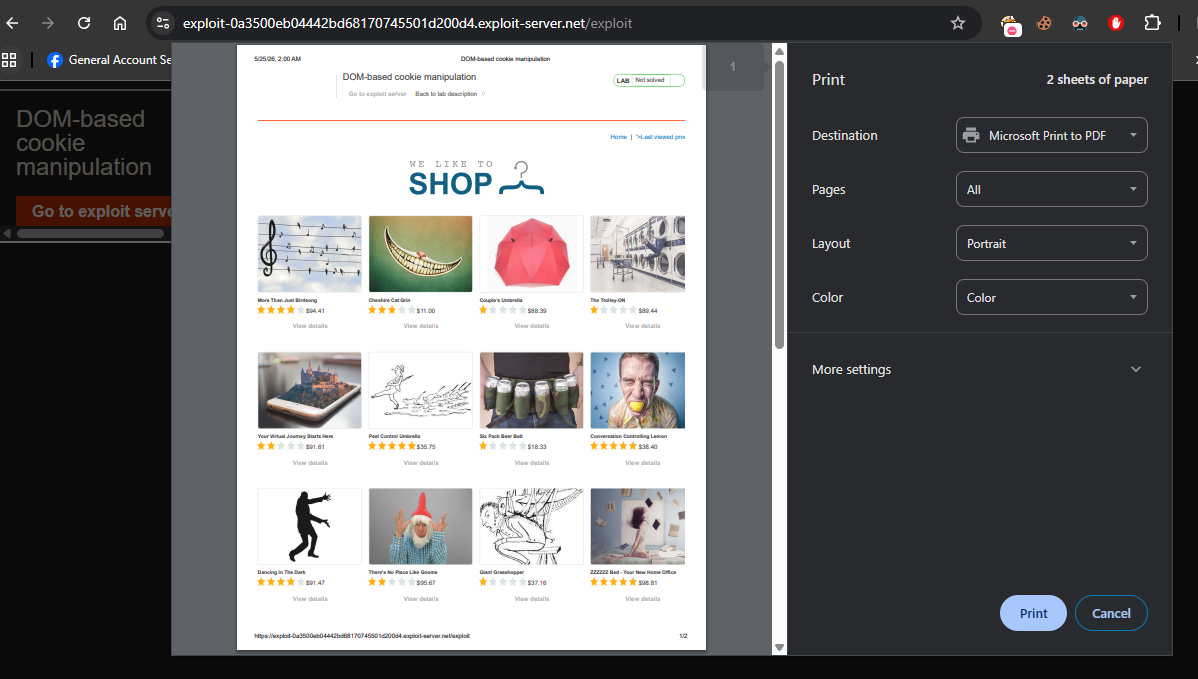
- Click View exploit
Expected result: The print() dialog appears.
Step 6: Delivering to the Victim
- Click Deliver exploit to victim
- The lab solves when the victim’s browser executes the payload
Step 7: Lab Solved
Success message displayed:
