HTB

HTB Espresso Writeup
Category: Hardware
Difficulty: Easy
Platform: HackTheBox
Challenge Description
Someone leaked the new Espresso firmware, can you try to figure out what it does?
We are provided with a single file:
firmware.bin(4 MiB) The objective is to analyze the firmware, understand what it does, and extract the flag.
Initial Analysis
First, check what kind of file this is:
file firmware.bin
# Output: data
file command doesn’t recognize it. Manually inspect the hex:
python3 -c "
with open('firmware.bin','rb') as f:
    data = f.read()

# Find first non-FF byte
i = 0
while i < len(data) and data[i] == 0xFF:
    i += 1
print('First non-FF byte at:', hex(i))
print(data[i:i+64])
"
Output:
First non-FF byte at: 0x1000
b'\xe9\x03\x02 D\x06\x08@\xee...v6.1-dev-2748-g490691bc6'

First 0x1000 bytes are 0xFF — classic erased flash padding. Real content starts at 0x1000. The magic byte 0xE9 is the ESP32 bootloader signature.
Identifying the Format
Use esptool to parse the image:
pip install esptool
python3 -m esptool --chip esp32 image-info firmware.bin
Output:
Project name: espresso
App version:  2c1ec8fd-dirty
Compile time: Feb 28 2026 03:10:39
Chip ID:      0 (ESP32)
Entry point:  0x400814ac
ESP-IDF:      v6.1-dev-2748-g490691bc61
This is a full ESP32 flash dump. Parse the partition table at 0x8000:
import struct
data = open('firmware.bin','rb').read()
off = 0x8000
while True:
    entry = data[off:off+32]
    if entry[:2] != b'\xaaP': break
    magic, ptype, subtype, addr, size = struct.unpack('<HBBII', entry[:12])
    label = entry[12:28].split(b'\x00')[0].decode()
    print(hex(addr), hex(size), label)
    off += 32
Output:
0x9000   0x6000   nvs
0xf000   0x1000   phy_init
0x10000  0x100000 factory   ← main app
| Partition | Offset | Size | Purpose |
|---|---|---|---|
| nvs | 0x9000 | 24 KB | Non-volatile storage |
| phy_init | 0xF000 | 4 KB | WiFi PHY calibration |
| factory | 0x10000 | 1 MB | Main application |
Static Analysis — Strings
strings -n 6 firmware.bin | grep -v "^ESP_ERR\|IDF/components"Three suspicious strings stand out, clustered together in the binary:
flag did not generate correctly.
It seems you are running the firmware on cloned hadware.
Buy the real hardware, or perhaps try to emulate it. ;)
The third string is a direct hint from the challenge author:
“try to emulate it”
Further string analysis reveals the internal logic:
get_efuse_factory_mac    ← reads unique chip MAC from eFuse BLK0
main                     ← logging TAG used for ESP_LOG
Key finding: No flag string exists anywhere in the binary. The flag is generated at runtime from the chip’s eFuse MAC address — it only appears when the firmware detects it is running on genuine Espressif hardware.
The logic flow is:
Boot
 └─► read eFuse MAC address
       ├─► MAC valid (genuine chip) → generate flag → print over UART
       └─► MAC invalid (clone)      → print "cloned hardware" error
Building Espressif QEMU
Standard QEMU does not support ESP32. Espressif maintains an official fork with full Xtensa/ESP32 machine emulation.
Install Dependencies
sudo apt install -y libglib2.0-dev libpixman-1-dev libgcrypt-dev \
  libslirp-dev libfdt-dev zlib1g-dev libssl-dev cmake ninja-build
Clone and Build
git clone https://github.com/espressif/qemu.git
cd qemu

# Note: omit --enable-debug to avoid -Werror breaking build on GCC 15
./configure --target-list=xtensa-softmmu --enable-gcrypt

make -j$(nproc)
# Build takes ~15 minutes
Emulating the Firmware
cd ~/Downloads/hw_espresso

qemu/build/qemu-system-xtensa \
  -machine esp32 \
  -drive file=firmware.bin,if=mtd,format=raw \
  -nographic \
  -serial mon:stdio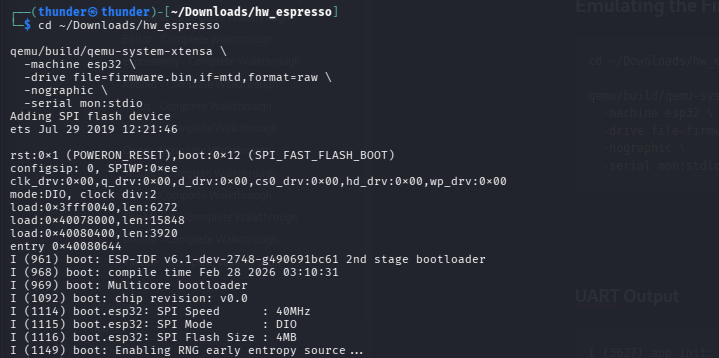
UART Output
I (3627) app_init: Project name:     espresso
I (3628) app_init: App version:      2c1ec8fd-dirty
I (3629) app_init: Compile time:     Feb 28 2026 03:10:39
I (3634) efuse_init: Min chip rev:   v0.0
I (3637) efuse_init: Chip rev:       v0.0
I (3931) main_task: Started on CPU0
I (3971) main_task: Calling app_main()
I (3991) main: HTB{**************************}
I (3991) main_task: Returned from app_main()
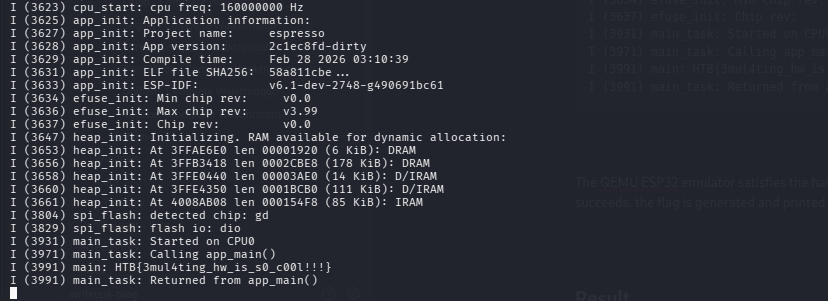
The QEMU ESP32 emulator satisfies the hardware genuineness check — the eFuse MAC read succeeds, the flag is generated and printed over the virtual UART.
Result
HTB{**************************************}
Challenge Solved
Communication Flow
firmware.bin
      │
      ▼
┌─────────────────────────┐
│  ESP32 Flash Layout     │
├─────────────────────────┤
│  Bootloader  @ 0x1000   │
│  Part. Table @ 0x8000   │
│  NVS         @ 0x9000   │
│  Factory App @ 0x10000  │
└─────────────────────────┘
      │
      ▼
┌─────────────────────────┐
│  app_main()             │
│  get_efuse_factory_mac()│
│  → flag generation      │
│  → UART print           │
└─────────────────────────┘
      │
      ▼
 HTB{********************************}
Conclusion
Although this is a hardware challenge, HTB Espresso requires no physical hardware at all. The key insight is recognizing that:
- The firmware performs an eFuse-based hardware authenticity check
- The flag is never stored statically — it is derived at runtime from the chip MAC
- The challenge hint “try to emulate it” directly points to the solution
Using Espressif’s official QEMU fork, the ESP32 environment is faithfully emulated — including eFuse reads — allowing the firmware to pass its hardware check and reveal the flag over the virtual serial port.
This challenge is an excellent introduction to firmware analysis, embedded systems emulation, and the ESP32 platform commonly seen in IoT hardware challenges.
Written by: Pasindu (W.P.S.D. Wijesinghe)
Blog: pasindu-sd.github.io/writeups-blog