HTB

HTB Baby Frame Writeup
Category: Satellite Technology
Difficulty: Very Easy
Platform: HackTheBox
Challenge Description
A recently recovered experimental spacecraft broadcasting under spacecraft ID 12 has entered visibility range. Ground telemetry suggests that one onboard diagnostic application remains active on APID 42 over virtual channel 3. Mission operators believe the service is waiting for a single correctly formatted CCSDS space packet containing the user payload HEALTHCHECK.
Your task is to establish communication with the spacecraft and trigger the diagnostic response.
We are provided with a zip file containing a minimal client.py template with two incomplete functions:
generate_space_packet()generate_tc_frame()
The objective is to implement these functions according to the official CCSDS specifications and successfully communicate with the remote spacecraft simulator.
Initial Analysis
The provided client performs the following operations:
space_packet = generate_space_packet(
    apid=42,
    packet_count=0,
    payload=b"TEST_PAYLOAD"
)

frame = generate_tc_frame(
    spacecraft_id=12,
    virtual_channel_id=3,
    tc_packet_count=0,
    payload=space_packet
)

payload = frame + space_packet
From the challenge description, we know the required values:
| Field | Value |
|---|---|
| Spacecraft ID | 12 |
| Virtual Channel | 3 |
| APID | 42 |
| Payload | HEALTHCHECK |
The two protocol references included with the challenge immediately point us toward the official CCSDS standards:
- CCSDS Space Packet Protocol
- CCSDS Telecommand (TC) Space Data Link Protocol
This indicates that the challenge is primarily a protocol implementation exercise rather than a traditional exploitation challenge.
Understanding the CCSDS Space Packet
A CCSDS Space Packet begins with a fixed 6-byte Primary Header.
 0                   1                   2                   3
 +-+-+-+-+-+-+-+-+-+-+-+-+-+-+-+-+-+-+-+-+-+-+-+-+-+-+-+-+-+-+-+-+
 |Ver|Type|SHF|               APID                               |
 +-+-+-+-+-+-+-+-+-+-+-+-+-+-+-+-+-+-+-+-+-+-+-+-+-+-+-+-+-+-+-+-+
 |Sequence Flags|      Packet Sequence Count                     |
 +-+-+-+-+-+-+-+-+-+-+-+-+-+-+-+-+-+-+-+-+-+-+-+-+-+-+-+-+-+-+-+-+
 |            Packet Length                                      |
 +-+-+-+-+-+-+-+-+-+-+-+-+-+-+-+-+-+-+-+-+-+-+-+-+-+-+-+-+-+-+-+-+
The header consists of three 16-bit words.
First Header Word
The first word contains:
- Version = 0
- Packet Type = 1 (Telecommand)
- Secondary Header Flag = 0
- APID = 42
This is packed as:
word1 = (version << 13) | (packet_type << 12) | (secondary_header << 11) | apidWhich evaluates to 0x102A.
Second Header Word
The second word stores:
- Sequence Flags =
0b11(Unsegmented Packet) - Packet Sequence Count = 0
This becomes:
word2 = (0b11 << 14) | packet_countWhich evaluates to 0xC000.
Packet Length
Unlike most protocols, CCSDS stores:
Packet Length = Data Length - 1The payload is HEALTHCHECK, which is 11 bytes. Therefore:
Length = 10 (0x000A)Final Space Packet
The packet layout becomes:
+----------------------+
| Primary Header (6B)  |
+----------------------+
| HEALTHCHECK          |
+----------------------+
Understanding the Telecommand Frame
The Telecommand Transfer Frame acts as the transport layer for the Space Packet.
The primary header contains:
- Spacecraft ID
- Virtual Channel ID
- Frame Length
- Sequence Number
For this challenge:
Spacecraft ID = 12
VCID          = 3
Sequence      = 0
The interesting observation is that the provided template later performs:
payload = frame + space_packetinstead of embedding the packet inside generate_tc_frame().
Therefore generate_tc_frame() only returns the 5-byte TC Primary Header, while the client appends the Space Packet afterwards.
The transmitted data therefore looks like:
+--------------------+
| TC Header (5B)     |
+--------------------+
| Space Packet       |
+--------------------+
This matches the expected packet layout for the challenge service.
Packet Construction
Space Packet
def generate_space_packet(apid: int, packet_count: int, payload: bytes) -> bytes:
    word1 = (0 << 13) | (1 << 12) | (0 << 11) | (apid & 0x7FF)
    # Word 2: Sequence Flags(2b)=0b11 (Standalone) | Sequence Count(14b)
    word2 = (0b11 << 14) | (packet_count & 0x3FFF)
    # Word 3: Packet Data Length = (payload length) - 1
    word3 = len(payload) - 1
    # Pack the 6-byte primary header (big-endian) and append the payload
    packet = struct.pack(">HHH", word1, word2, word3) + payload
    return packet
TC Frame Header
def generate_tc_frame( spacecraft_id: int, virtual_channel_id: int, tc_packet_count: int, payload: bytes) -> bytes:
    # Word 1: Version(2b)=0 | Bypass(1b)=0 | Ctrl(1b)=0 | Spare(2b)=0 | SCID(10b)
    word1 = (0 << 14) | (0 << 13) | (0 << 12) | (0 << 10) | (spacecraft_id & 0x3FF)
    # Word 2: VCID(6b) | Frame Length(10b)
    # Frame Length = (Total frame length) - 1
    # Total = 5 (TC header) + len(payload) (space packet) + 2 (CRC)
    frame_length = 5 + len(payload) - 1
    word2 = ((virtual_channel_id & 0x3F) << 10) | (frame_length & 0x3FF)
    # Word 3: VCFC(8b) | Spare(8b)
    # Pack as 2 bytes: first byte = count, second byte = 0
    frame = struct.pack(">HHB", word1, word2, tc_packet_count & 0xFF)
    return frame
Where the application payload is:
b"HEALTHCHECK"Communication Flow
The completed packet follows this structure:
TCP Connection
                      │
                      ▼
        ┌──────────────────────────┐
        │ TC Transfer Frame Header │
        └──────────────────────────┘
                      │
                      ▼
        ┌──────────────────────────┐
        │ CCSDS Space Packet       │
        ├──────────────────────────┤
        │ Primary Header (6 bytes) │
        ├──────────────────────────┤
        │ HEALTHCHECK              │
        └──────────────────────────┘
                      │
                      ▼
          Diagnostic Service (APID 42)
The onboard diagnostic application validates:
- Spacecraft ID = 12
- Virtual Channel = 3
- APID = 42
- Payload =
HEALTHCHECK
If all fields are correctly encoded according to the CCSDS specifications, the spacecraft responds with the challenge flag.
Result

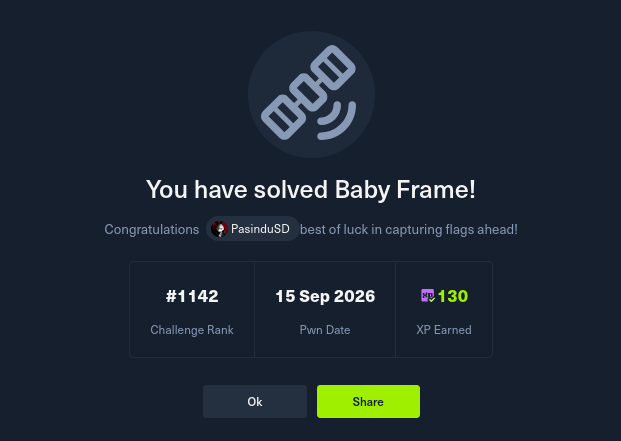
Challange Solved
Conclusion
Although classified as a “Very Easy” challenge, HTB Baby Frame provides an excellent introduction to real-world satellite communication protocols and demonstrates how spacecraft exchange telecommands using CCSDS standards. It reinforces the importance of reading protocol specifications carefully — especially the subtle off-by-one encoding rules that are unique to CCSDS.
This challenge is highly recommended for anyone interested in aerospace cybersecurity or embedded protocol analysis.
Written by: Pasindu (W.P.S.D. Wijesinghe)
Blog: pasindu-sd.github.io/writeups-blog